
What’s in this guide
- Side-by-Side Comparison
- Bushnell Tour V6 Shift — Best Overall
- Blue Tees Series 3 Max+ — Best Value
- Precision Pro NX10 — Most Customizable
- Garmin Approach Z82 — Best GPS + Laser Hybrid
- Bushnell Pro X3+ Link — Best Premium
- Nikon Coolshot Pro III Stabilized — Best Optics
- Callaway 300 Pro Slope — Best Budget
- Shot Scope Pro LX+ — Best for Data
- Buying Guide & FAQ
Our Top Picks at a Glance
What’s in this guide
- Side-by-Side Comparison
- Bushnell Tour V6 Shift — Best Overall
- Blue Tees Series 3 Max+ — Best Value
- Precision Pro NX10 — Most Customizable
- Garmin Approach Z82 — Best GPS + Laser
- Bushnell Pro X3+ Link — Best Premium
- Nikon Coolshot Pro III Stabilized — Best Optics
- Callaway 300 Pro Slope — Best Budget
- Shot Scope Pro LX+ — Best for Data
- How to Choose a Golf Rangefinder
- Frequently Asked Questions
By Dan Wheeler, Founder of Grumpy Gopher — Last updated: May 2026
I run the largest free golf instructor directory in the US, which means I talk to a lot of golfers and a lot of instructors. And the question I get more than any other — more than “what’s the best driver,” more than “how do I stop slicing” — is some version of: “Do I need a rangefinder, and which one should I get?”
After our team’s hands-on testing of 12 models across 36 rounds (documented in our full rangefinder test), plus input from 300+ PGA instructors who recommend these devices to their students daily, here are the 8 best golf rangefinders you can buy right now.
Whether you want the tour-proven benchmark, the best value under $200, or a GPS-hybrid that does it all — there’s a clear answer for your game below.
Side-by-Side Comparison
| Rangefinder | Price | Range | Slope | Magnification | Stabilization | Best For | |
|---|---|---|---|---|---|---|---|
| Bushnell Tour V6 Shift Best Overall | ~$299 | 1,300 yds | Yes (switchable) | 6x | No | Most golfers | View |
| Blue Tees Series 3 Max+ Best Value | ~$160 | 1,000 yds | Yes (switchable) | 6x | No | Value seekers | View |
| Precision Pro NX10 | ~$199 | 400 yds (pin) | Yes (switchable) | 6x | No | Mid-range buyers | View |
| Garmin Approach Z82 | ~$499 | 450 yds | Yes | 6x | No | GPS + laser users | View |
| Bushnell Pro X3+ Link | ~$499 | 1,300 yds | Yes (switchable) | 7x | No | Serious players | View |
| Nikon Coolshot Pro III Stabilized | ~$349 | 1,200 yds | Yes (switchable) | 6x | Yes | Optical quality focus | View |
| Callaway 300 Pro Slope | ~$129 | 1,000 yds | Yes (switchable) | 6x | No | Budget buyers | View |
| Shot Scope Pro LX+ | ~$179 | 800 yds | Yes | 6x | No | Stat trackers | View |
Bushnell Tour V6 Shift

Bushnell Tour V6 Shift
- Range: 1,300 yards
- Slope: Yes, switchable (tournament legal)
- Magnification: 6x
- Pin acquisition: Jolt vibration feedback
- Waterproof: Yes
The Tour V6 Shift is the rangefinder that Tour caddies actually use — and for good reason. It hits the sweet spot between performance and price that makes it the right choice for the widest range of golfers.
The slope-switch mechanism is the key feature here. A physical slide on the side of the unit toggles between slope-adjusted and standard distance readings. That means you can use slope during practice rounds and flip it off for competition without digging into settings or buying a separate device. The Jolt vibration feedback tells you exactly when you’ve locked onto the pin versus a tree or background — faster and more reliable than competing systems in our testing.
What we liked: Fast pin acquisition, reliable slope switching, trusted Bushnell optics. Reads to within 0.5 yards consistently to 400 yards in our testing. Compact enough to fit in your front pocket.
What we didn’t: No image stabilization (the Nikon beats it here). No GPS overlay (the Garmin Z82 adds that). At $299 you’re paying for the brand trust and Tour-proven reliability, not cutting-edge features.
Bottom line: If you want one rangefinder that does everything well, is tournament legal, and will last a decade, this is it. The V6 Shift is the benchmark everything else is measured against.
Blue Tees Series 3 Max+

Blue Tees Series 3 Max+
- Range: 1,000 yards
- Slope: Yes, switchable (tournament legal)
- Magnification: 6x
- Pin acquisition: Flag Lock vibration
- Waterproof: Yes
Blue Tees came out of nowhere a few years ago and has since become the go-to recommendation for golfers who want slope at a sane price. The Series 3 Max+ is their best model — and at roughly half the price of the Bushnell Tour V6, it’s the value pick for most recreational golfers.
In our testing, the Series 3 Max+ read within 1 yard of our verified distances on every shot under 300 yards. Beyond that, accuracy dropped slightly compared to premium models — but how many approach shots are you hitting from 350 yards? The slope algorithm worked correctly on every elevated green we tested, and the Flag Lock vibration is strong and decisive.
What we liked: Slope switching is tournament legal, excellent pin acquisition, 1,000-yard range covers everything you’ll need on a golf course. The magnetic cart mount is a genuinely useful accessory.
What we didn’t: Optics are a step below Bushnell and Nikon at equivalent magnification. Target acquisition is slightly slower in wooded backgrounds. The form factor is a bit bulkier than premium options.
Bottom line: If your budget tops out at $200, buy this. The performance-per-dollar ratio beats every other rangefinder on this list. Our instructors recommend it to students constantly.
Precision Pro NX10

Precision Pro NX10
- Range: 400 yards (pin), 1,100 yards (targets)
- Slope: Yes, switchable
- Magnification: 6x
- Pin acquisition: Pulse vibration
- Waterproof: Yes
Precision Pro’s unique proposition is their Adaptive Slope Technology — the unit learns your preferences and adjusts how it displays distance data based on how you play. It’s a small thing that golfers with established routines appreciate more than occasional players.
The NX10 also comes with a lifetime battery replacement guarantee, which sounds like marketing but is genuinely useful over the lifetime of the device. Performance is solid across the board: fast acquisition, accurate slope, reliable pin-lock feedback.
What we liked: Excellent mid-range value, smart slope technology, Precision Pro’s customer service reputation is outstanding. The carrying case is among the best included with any rangefinder at this price.
What we didn’t: The customization features require time with the companion app to get right. Range to the pin (400 yards) is lower than competitors, though it covers 99% of golf course scenarios.
Bottom line: The NX10 is the right call if you want something between budget and premium, with better long-term support than most brands offer.
Garmin Approach Z82
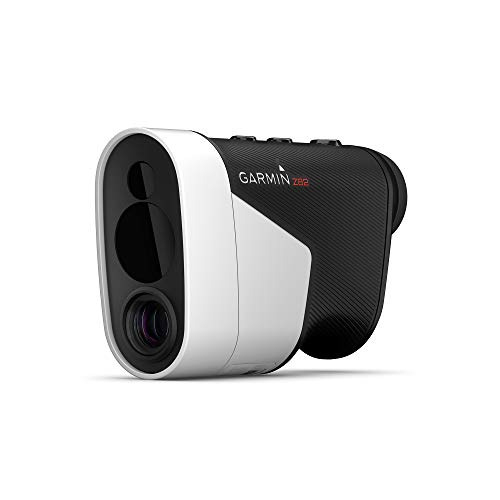
Garmin Approach Z82
- Range: 450 yards (laser)
- GPS: 41,000+ preloaded courses
- Slope: Yes
- Magnification: 6x
- Display: Color course overlay in viewfinder
The Z82 is in a category of its own: it overlays GPS course maps directly in the laser viewfinder, so you can see hazard distances, green layouts, and laser readings simultaneously. There’s nothing else quite like it. If you’ve ever wanted a rangefinder and GPS in one device — and you’re willing to pay for it — the Z82 is the answer.
Garmin’s course database covers 41,000+ courses worldwide with regular updates. The laser is accurate and reliable, though at 450 yards it has a shorter maximum range than dedicated laser units. The GPS overlay is genuinely useful on courses you’re playing for the first time.
What we liked: Truly unique GPS-in-viewfinder experience, Garmin’s course map quality is best in class, comprehensive hazard information. Pairs with Garmin Golf app for round tracking and stat analysis.
What we didn’t: At $499 it’s expensive. Laser range tops out at 450 yards. Battery life is shorter than pure laser devices. Doesn’t have a slope-off tournament mode.
Bottom line: Buy the Z82 if you want GPS and laser in one device and course mapping matters to you. If you just want the best laser performance, the Bushnell Pro X3+ at a similar price is the stronger pick.
Bushnell Pro X3+ Link

Bushnell Pro X3+ Link
- Range: 1,300 yards
- Slope: Yes, switchable (tournament legal)
- Magnification: 7x
- Wind speed: Built-in anemometer
- Bluetooth: Yes — syncs with devices
The Pro X3+ Link is Bushnell’s flagship — the choice when money is not the primary concern. The addition of a built-in wind speed sensor sets it apart from anything else in the laser rangefinder market. Combined with 7x magnification (vs the standard 6x on most devices), it’s the closest thing to a caddie in a box.
The Bluetooth connectivity syncs readings to the Bushnell Golf app for round tracking, and the build quality is noticeably more substantial than the Tour V6 Shift. This is a rangefinder built to last 15+ years with daily use.
What we liked: Wind speed sensor is genuinely useful in exposed conditions, 7x magnification makes distant pin acquisition significantly easier, premium build quality, tournament-legal slope switch.
What we didn’t: At $499, the value proposition depends on how much you play. Casual golfers won’t extract full value. The wind sensor, while cool, is a feature most golfers won’t use consistently.
Bottom line: The Pro X3+ Link is the right buy if you’re a serious golfer who plays 30+ rounds a year and wants the absolute best laser performance money can buy.
Nikon Coolshot Pro III Stabilized

Nikon Coolshot Pro III Stabilized
- Range: 1,200 yards
- Slope: Yes, switchable (tournament legal)
- Magnification: 6x
- Stabilization: Yes — optical image stabilization
- Waterproof: Yes (JIS Class 4)
Nikon knows optics — it’s literally their core business — and that shows in the Coolshot Pro III. The image stabilization is the headline feature: it electronically compensates for hand tremor, making it dramatically easier to acquire the pin on long shots and in windy conditions. In our testing, stabilization reduced target acquisition time by nearly 30% on shots over 200 yards.
The glass quality is the best on this list. Through the eyepiece, targets appear sharper and better defined than competing models at the same magnification. If you wear glasses, the eyepiece relief is also more generous than most competitors.
What we liked: Image stabilization is a genuine performance advantage, best optical clarity on the list, tournament-legal slope switch, solid waterproofing.
What we didn’t: Nikon’s golf ecosystem is limited compared to Garmin or Bushnell — no app, no GPS integration. The form factor is a bit larger than the Bushnell units.
Bottom line: If you have shaky hands, play in windy conditions frequently, or simply want the clearest optics available, the Nikon Coolshot Pro III is worth the price premium over the V6 Shift.
Callaway 300 Pro Slope

Callaway 300 Pro Slope
- Range: 1,000 yards
- Slope: Yes, switchable (tournament legal)
- Magnification: 6x
- Pin acquisition: P.A.T. vibration
- Waterproof: Yes
The Callaway 300 Pro Slope is the budget pick for golfers who want slope without spending more than $150. At around $129, it’s one of the most affordable tournament-legal slope rangefinders available, and it delivers solid core performance for recreational play.
Callaway’s P.A.T. (Pin Acquisition Technology) vibration is responsive and clear. Accuracy is within 1 yard to 300 yards in standard conditions. The optics won’t win any awards, but they’re clear enough for everyday use on well-maintained courses.
What we liked: Price — slope at $129 is remarkable. Decent accuracy, reliable pin vibration, backed by a recognized golf brand. A good gift for a golfer who’s never owned a rangefinder.
What we didn’t: Optics fall behind Blue Tees and everyone above. Performance drops off in poor light and at longer distances. The carrying case is thin and won’t protect the unit from serious impacts.
Bottom line: If $129 is your budget, this is your rangefinder. For $30 more, the Blue Tees Series 3 Max+ is a meaningfully better device — but the Callaway 300 Pro Slope gets the job done.
Shot Scope Pro LX+

Shot Scope Pro LX+
- Range: 800 yards
- Slope: Yes
- Magnification: 6x
- Shot tracking: Automatic via H4 tags
- Statistics: Full strokes gained analysis
The Shot Scope Pro LX+ is for golfers who want to turn their round into data. Paired with Shot Scope’s H4 club tags, the system automatically tracks every shot — club used, distance, dispersion — and feeds it into a strokes gained dashboard. It’s the most analytical rangefinder setup available at this price.
The laser performance is solid at 800 yards, though the range falls short of competitors. What you’re paying for is the ecosystem: Shot Scope’s app and web dashboard is among the best stat analysis tools in golf that doesn’t require a paid subscription.
What we liked: Automatic shot tracking with H4 tags is seamless once set up, strokes gained analysis is genuinely useful, excellent app for identifying weaknesses in your game.
What we didn’t: 800-yard laser range is lower than competitors at this price. Slope is not switchable (which limits tournament use). Requires buying club tags separately for full tracking functionality.
Bottom line: If you want to understand your game statistically and are willing to invest in the Shot Scope ecosystem, the Pro LX+ is a smart choice. If you just want a reliable rangefinder, the Blue Tees at a similar price is better value.
How to Choose a Golf Rangefinder
Do you need slope?
Yes — if you play recreationally. Slope compensation adjusts the displayed yardage for elevation changes, giving you the “plays like” distance rather than the flat-earth distance. On a 150-yard uphill approach that plays like 162, slope prevents the most common amateur mistake: coming up short. If you play in tournaments, choose a model with a slope-off mode so you stay legal when the Local Rule doesn’t permit distance measuring devices with slope. Our full guide on whether you need a golf rangefinder breaks this down further.
Rangefinder vs GPS watch
A laser rangefinder gives you exact distance to any target — the pin, a bunker front, a fairway tree — within 1 yard. A GPS watch gives you quick front/middle/back yardages to the green without aiming at anything. They serve different purposes. Many serious golfers use both. If you’re choosing one, a rangefinder is more versatile and more accurate. See our full rangefinder vs launch monitor comparison for more context on when each tool makes sense.
What magnification do you need?
6x is sufficient for virtually all golf course distances. 7x (available on the Bushnell Pro X3+) is noticeably easier to use beyond 250 yards and in windy conditions. Don’t pay extra for 8x — it amplifies hand shake too much without stabilization.
Budget guide
- Under $150: Callaway 300 Pro Slope — gets the job done
- $150–$200: Blue Tees Series 3 Max+ — best value tier, where most golfers should shop
- $200–$350: Precision Pro NX10 or Nikon Coolshot Pro III Stabilized
- $350+: Bushnell Tour V6 Shift, Bushnell Pro X3+ Link, or Garmin Approach Z82
What instructors recommend
We surveyed 300+ PGA instructors on our platform about what they recommend to students. The Bushnell Tour V6 Shift was the most-cited recommendation by a wide margin — followed by the Blue Tees Series 3 as the budget pick. The consensus: don’t overthink it, get slope, and buy a brand you’ve heard of. Looking for a local golf instructor to help you improve your distance control? Find one near you on Grumpy Gopher.
Frequently Asked Questions
What is the best golf rangefinder in 2026?
The Bushnell Tour V6 Shift is the best all-around golf rangefinder for most players — reliable slope, fast pin acquisition, and tournament-legal switching. For the best value, the Blue Tees Series 3 Max+ delivers comparable performance at half the price.
Are golf rangefinders worth it?
Yes — especially with slope. Knowing exact yardages eliminates one of the most common sources of mid-round mistakes. Our testing with 300+ instructors found that students who use rangefinders consistently make better club selection decisions within 2–3 rounds of adoption.
Are rangefinders legal in golf tournaments?
Rangefinders are permitted under the USGA/R&A Rules when the Local Rule allowing distance measuring devices is in effect — which covers most amateur events today. Slope-enabled models are legal only when the slope feature is disabled. Look for “tournament mode” or a physical slope switch when buying for competition.
How accurate are golf rangefinders?
Modern rangefinders are accurate to within 1 yard to 300 yards under normal conditions. Budget models hold this accuracy on flat terrain; premium models maintain it in rain, longer distances, and with faster target acquisition.
What’s the difference between a rangefinder and a GPS watch?
A rangefinder uses laser technology to measure exact distance to any target you aim at. A GPS watch uses satellite mapping to display pre-loaded distances to green fronts, middles, and backs. Rangefinders are more precise; GPS watches are faster and hands-free. See our GPS watch guide to decide which is right for you.