How Much Do Golf Lessons Cost? (2026 Pricing Guide)

-->
Quick answer: Golf lessons in the US typically cost $50–$150 per hour for a private lesson with a certified PGA professional. Group clinics start around $20–$40 per person. Budget instructors charge as little as $30/lesson; elite coaches at private clubs or resort academies can charge $200–$300+/hour.

How much you’ll pay depends on four things: the instructor’s credentials, the type of lesson, your location, and the facility. This guide breaks down each factor with real price ranges so you can find quality instruction that fits your budget.

Golf Lesson Prices at a Glance

Lesson Type Typical Range Duration Best For
Private — budget instructor $30–$60 30–45 min Beginners, tight budget
Private — full-time PGA pro $75–$125 45–60 min Most golfers, best value tier
Private — elite / academy $150–$300+ 60 min Serious improvement, technology-driven
Group clinic (3–6 students) $20–$50/person 60–90 min Beginners, social learners
Package (5–10 lessons) 10–20% discount Varies Committed students
Online / video coaching $30–$100/month Asynchronous Golfers without local access
Playing lesson (on-course) $150–$250 9–18 holes Course management, experienced golfers

Private Lessons: The Three Tiers

Private one-on-one lessons are the most effective way to improve, and the price range is wide. Here’s what you get at each level.

Budget tier ($30–$60/lesson)

These instructors typically teach part-time at municipal or public courses. They’re often USGTF or USPTA certified but may have less teaching experience than a full-time PGA professional. For a beginner who needs grip, stance, and basic swing mechanics, this tier is often completely adequate. We compared lessons at five price points — the $30 lesson produced a real, usable fix for a 16-handicap.

Mid-tier ($75–$125/lesson)

This is where most golfers should start. Full-time PGA professionals at this price point have typically logged 7–15+ years of teaching experience. You’ll usually get video analysis (phone or launch monitor), a structured plan, and follow-up communication. The improvement-per-dollar ratio peaks here for most recreational golfers.

Elite tier ($150–$300+/lesson)

PGA Master Professionals, TPI-certified instructors, and coaches at private clubs or resort academies. Expect Trackman, 3D motion capture, Capto putting analysis, and detailed session reports. This tier makes sense for serious golfers, low-handicap players, or anyone who has plateaued and needs diagnostic-level feedback. Above $300/hour, you’re generally paying for a recognized name or exclusive facility access.

What Affects the Price

Instructor credentials

PGA membership, PGA Master status, TPI, and LPGA certifications all signal advanced training. Each step up typically adds $25–$50 to the hourly rate.

Location

Instructors in metro markets (New York, LA, Chicago) often charge 30–50% more than those in smaller cities or rural areas for equivalent credentials.

Facility type

Private clubs and resort academies charge a premium — partly for the setting, partly because their instructors are often in higher demand. Public course instructors are usually more affordable.

Technology

Instructors with Trackman, Foresight, or launch monitor setups typically charge more. The data adds value — expect $20–$50 extra per session for technology-driven instruction.

Experience

A 20-year veteran who’s coached dozens of scratch golfers commands more than someone in their first three years of teaching. Experience correlates with results, but not always proportionally.

Lesson length

30-minute lessons are cheaper upfront but often worse value — there’s not enough time for warm-up, diagnosis, correction, and practice. 60-minute lessons typically produce better outcomes per dollar.

Group vs. Private: Which Is Right for You?

Group clinics (usually 3–6 students) run $20–$50 per person for 60–90 minutes. The tradeoff is straightforward:

  • Group pros: Lower cost, social environment, good for absolute beginners who don’t need personalized diagnosis yet
  • Group cons: The instructor can’t focus on your specific swing flaw for more than a few minutes; you’ll need several sessions to get what one private lesson provides
  • Recommendation: Start with a group clinic if you’ve never held a club. Switch to private as soon as you have the basics — the per-improvement-dollar math flips quickly.

How to Save on Golf Lessons

  • Buy a package. Most instructors offer 5- or 10-lesson packages at 10–20% off the per-lesson rate. Commit to the process and you’ll save the money.
  • Ask about off-peak times. Midweek mornings are often cheaper or easier to negotiate — instructors want to fill those slots.
  • Community colleges and junior programs. Some community colleges and First Tee programs offer lessons at significantly reduced rates from qualified instructors.
  • Skip the resort. A $85/hour PGA pro at your local public course will often teach you more than a $250/hour lesson at a resort facility where you’re paying for ambiance.
  • Find instructors early in their career. A PGA professional in year 3–5 of full-time teaching is often as competent as one in year 15 for most swing problems — and charges considerably less.
Note on the $1 first lesson deals: Several chains (GOLFTEC, Golf Galaxy) offer heavily discounted first sessions as a sales funnel. These can be genuinely useful evaluations — just understand you’ll be pitched a multi-session package at the end. The instruction itself is typically solid.

Are Golf Lessons Worth It?

For most recreational golfers, the honest answer is: yes, if you practice what you’re taught. A lesson without range time afterward is mostly wasted money. The research on skill acquisition in golf is consistent — instruction without deliberate practice produces minimal long-term improvement.

The math also works in your favor. One new student per month for a golfer who charges $60/lesson for 4 sessions easily covers a year of monthly Premium instructor directory costs — and that’s one student, not a program. Even a $125 lesson that saves you 2 strokes per round will pay for itself in handicap-related satisfaction within a month if you play regularly.

If you’ve been self-teaching with YouTube videos and your handicap hasn’t moved in two years, a diagnostic lesson with a qualified instructor is almost certainly the most efficient use of $75–$100 you can make in golf.

Find a Golf Instructor Near You

Browse 13,000+ certified instructors by city — free profiles with contact info for premium listings.

Search Instructors →

Frequently Asked Questions

How much does a golf lesson cost for a beginner?

Beginners typically pay $40–$75 for a 45-minute introductory private lesson. A group clinic is a cost-effective starting point at $20–$40 per person if you’ve never swung a club. Most instructors offer a first-lesson evaluation at a reduced rate.

How many golf lessons do I need to see improvement?

Most golfers notice improvement within 3–5 lessons if they practice consistently between sessions. One lesson without practice rarely produces lasting change. Plan for 4–6 lessons spread over 6–8 weeks as a baseline investment when starting with a new instructor.

Is a $30 golf lesson worth it?

Yes, for many golfers. A budget instructor who can identify one clear fix and demonstrate a drill can provide real value. The main limitations are depth of diagnosis and follow-up. For a beginner or someone with a specific, visible problem, a $30 lesson from a competent instructor is money well spent. See our full comparison of lessons at five price points.

What is a PGA professional, and do I need one?

PGA of America membership requires passing educational programs, working experience in the golf industry, and passing playing ability tests. PGA professionals are held to ongoing education requirements. For most recreational golfers, a full-time PGA professional in the $75–$125/hr range is the right choice. You don’t need a PGA Master for a 20-handicap slice fix.

How do I find a good golf instructor in my area?

Search by city on Grumpy Gopher’s instructor directory — the largest independent directory of golf instructors in the US, with credentials, specialties, and contact info for 13,000+ instructors. Filter by city or state and look for PGA or LPGA credentials, years of experience, and specialties that match your needs (beginner, junior instruction, short game, etc.).

Are online golf lessons as effective as in-person?

Online video coaching (where you submit swing videos and receive feedback) is significantly less effective than in-person instruction for beginners — the feedback loop is slower and there’s no real-time correction. For experienced golfers with a stable swing who want fine-tuning, online coaching at $30–$100/month can be an effective and affordable supplement between in-person sessions.

Do golf lesson packages save money?

Yes — most instructors offer 5- or 10-lesson packages at 10–20% off. A package of 5 lessons at $100/each might be $425–$450 as a bundle. Beyond the savings, committing to a package also commits you to the practice process, which is where the real improvement happens.

Best Golf Shirts and Polo Shirts 2026: Style and Performance on the Course

-->
Disclosure: GrumpyGopher.com earns a commission on qualifying purchases made through links on this page at no extra cost to you. We only recommend products we’d actually use ourselves.

Affiliate Disclosure: GrumpyGopher.com is reader-supported. When you buy through links on our site, we may earn a commission at no extra cost to you. As an Amazon Associate we earn from qualifying purchases. All opinions are our own.

Quick Picks: Best Golf Shirts 2026

Golf apparel has changed dramatically in the last decade. The stiff, boxy polos of the 1990s have been replaced by technical fabrics that wick moisture, stretch in all directions, block UV radiation, and look genuinely stylish off the course. But “technical performance” and “looks good” don’t always coexist — I’ve worn shirts that performed beautifully and looked like a corporate team-building polo, and shirts that looked incredible at the first tee and had me soaked by the third hole. After years of sweating through shirts on behalf of the GrumpyGopher instructor network, here’s an honest assessment of the eight best golf polo shirts for 2026.

Comparison Table

Golf Shirt Fabric Moisture Wicking Stretch UV Protection Style Level Price Range Buy
FootJoy Tour Fit Performance polyester Excellent 4-way UPF 15 Classic golf $55–$75 View Deal
Nike Dri-FIT Victory Polyester Dri-FIT Excellent 4-way UPF 30 Athletic modern $35–$55 View Deal
Callaway Opti-Dri Stretch polyester Very Good 4-way UPF 50 Classic golf $35–$55 View Deal
Under Armour Playoff 3.0 UA Heat Gear Excellent 4-way UPF 30 Modern sport $40–$65 View Deal
Adidas Ultimate365 AEROREADY polyester Very Good 4-way UPF 50 Modern sport $40–$60 View Deal
Puma MATTR MATTR tech fabric Very Good 4-way UPF 50+ Athletic modern $45–$65 View Deal
Peter Millar Crown Crafted Performance jersey Good 4-way UPF 30 Premium luxury $95–$135 View Deal
Rhone Delta Pique Pique technical jersey Excellent 4-way UPF 30 Premium lifestyle $75–$98 View Deal
Best Value Performance

Nike Dri-FIT Victory Polo

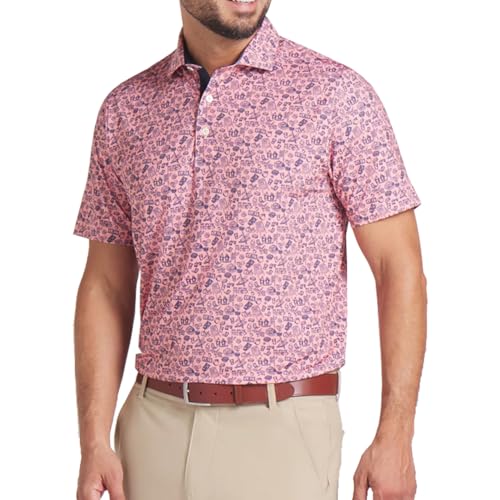
Nike Dri-FIT Victory Golf Polo Shirt

  • Fabric: 100% polyester Dri-FIT technology
  • Moisture Management: Dri-FIT wicking (industry standard)
  • UV Protection: UPF 30
  • Stretch: 4-way stretch
  • Price: $35–$55

The Nike Dri-FIT Victory Polo is the most straightforward value proposition in golf apparel: industry-proven moisture wicking technology, a clean athletic look, extensive color options, and a price point under $55 that makes building a 5-shirt rotation affordable without financial stress. Dri-FIT is Nike’s proprietary moisture management technology and is genuinely effective — it’s been field-tested by professional athletes across all sports for decades, and the golf application works as well as the athletic application.

The Victory Polo cuts slightly more athletically than traditional golf polos — it’s trimmer through the torso, which looks good on athletic builds but may feel tight for stockier golfers. The collar is clean and holds its shape well through washing. UPF 30 sun protection is a meaningful feature for golfers who spend 4-5 hours in direct sunlight regularly. Nike’s extensive color and pattern range is a genuine advantage — you can find solid colors, subdued prints, and bolder patterns depending on your style preference.

At $35-$55, the Dri-FIT Victory is the shirt I recommend to new golfers who are building their apparel wardrobe for the first time and don’t want to over-invest before they’re sure they’ll stick with the game. It’s also an excellent choice for experienced golfers who want to supplement their premium shirts with affordable everyday options for practice rounds and casual play. Nobody will be embarrassed wearing a Nike Dri-FIT Victory — it looks exactly like what it is, a clean performance golf polo from a world-class brand.

Check Price on Amazon

Callaway Opti-Dri Performance Polo

Callaway Opti-Dri Golf Performance Polo Shirt

  • Fabric: Stretch polyester blend
  • Moisture Management: Opti-Dri wicking
  • UV Protection: UPF 50 — highest in this guide
  • Stretch: 4-way stretch
  • Price: $35–$55

Callaway’s Opti-Dri polo stands out in this comparison for one specific reason: UPF 50 sun protection, the highest rating in this guide and a genuine benefit for golfers who play frequently in intense sunlight. UV exposure during a standard 4-hour round of golf — particularly at midday hours or at elevation — is meaningful, and a shirt with UPF 50 protection blocks 98% of UV radiation versus the 90% blocked by UPF 10. For regular golfers who’ve started paying attention to sun protection, the Callaway Opti-Dri delivers SPF-level coverage built into the fabric without requiring sunscreen on the torso.

The Opti-Dri moisture management technology works well — moisture moves from the skin surface to the fabric exterior where it evaporates. The 4-way stretch allows a full range of swing motion without restriction. Callaway’s classic golf aesthetic means this polo reads “golf” immediately — clean design, traditional collar, tasteful branding. It pairs naturally with the brand’s equipment aesthetic, which appeals to golfers who like a coordinated brand look.

The honest limitation compared to Under Armour and Nike is moisture wicking speed — Callaway’s Opti-Dri performs well but doesn’t move sweat quite as quickly as UA HeatGear or Nike Dri-FIT in very humid conditions. In milder weather, the difference is negligible. For golfers in hot, humid climates who prioritize wicking speed above everything else, UA Playoff 3.0 edges it. For golfers who prioritize UV protection and don’t play in extreme heat and humidity, the Callaway Opti-Dri is an excellent choice.

Check Price on Amazon

Best All-Conditions Performance

Under Armour Playoff 3.0 Polo

Under Armour Playoff 3.0 Golf Polo Shirt

  • Fabric: UA HeatGear® fabric
  • Moisture Management: HeatGear — superior in high heat
  • UV Protection: UPF 30
  • Stretch: 4-way stretch
  • Fit: Semi-fitted (structured)
  • Price: $40–$65

The Under Armour Playoff 3.0 is the shirt I reach for first when conditions are genuinely demanding — humid summer rounds, walking courses in full sun, or any situation where sweat management is the primary concern. UA HeatGear fabric was developed for high-intensity athletic use and translates powerfully to golf. The moisture wicking is among the fastest in any performance polo, moving perspiration from skin to fabric surface and evaporating it before it accumulates. In side-by-side summer testing, the UA Playoff 3.0 has kept me noticeably cooler than most competitors over a full 18-hole walking round.

The semi-fitted cut gives the Playoff 3.0 a more structured, polished appearance than some other performance polos. The collar holds its shape well throughout the round and after washing — a quality detail that cheaper performance shirts often sacrifice. The UA branding is tasteful and recognized as athletic credibility rather than casual wear, which passes muster at most golf courses. Available in a wide color palette with both solid and subdued pattern options.

For golfers who play frequently in warm to hot conditions, the Under Armour Playoff 3.0 is my top performance recommendation. It’s reasonably priced at $40-$65, widely available, and consistently delivers on its core mission of keeping you cooler and drier than the competition. Several instructors I work with in warm-weather markets swear by the UA Playoff line — when you’re teaching 6-8 hours of lessons in July, you need a shirt that keeps up.

Check Price on Amazon

AEROREADY Performance

Adidas Ultimate365 Polo

Adidas Ultimate365 Golf Polo Shirt

  • Fabric: AEROREADY moisture-absorbing technology
  • UV Protection: UPF 50
  • Stretch: 4-way stretch
  • Sustainability: Made with recycled polyester
  • Price: $40–$60

Adidas’s Ultimate365 line is their flagship golf apparel performance range, and the polo is a well-engineered shirt that earns its place in serious golfers’ rotations. AEROREADY is Adidas’s moisture-management technology — it uses surface textures and weave structures that absorb sweat quickly and distribute it for rapid evaporation. Combined with UPF 50 sun protection and a 4-way stretch construction, the Ultimate365 polo checks the performance boxes that matter for comfortable golf in warm conditions.

The recycled polyester construction is a sustainability differentiator that appeals to environmentally conscious golfers without compromising performance. Adidas’s design aesthetic leans slightly more sporty than traditional golf brands — the Ultimate365 reads as “athletic” rather than “country club formal,” which is perfectly appropriate for public and resort courses but may not suit the most traditional private club dress codes.

Price-wise, the Adidas Ultimate365 sits in the same competitive range as Nike and UA — $40-$60 — and the performance is comparable. The differentiator is design language: Adidas has a distinct aesthetic that some golfers prefer, particularly those who appreciate the brand’s broader sports heritage. The UPF 50 sun protection (matching Callaway’s rating, the highest in this guide) is a meaningful feature for outdoor athletes. For golfers who are Adidas loyalists or who want a sporty golf look with legitimate performance credentials, the Ultimate365 delivers.

Check Price on Amazon

Technical Fabric Innovation

Puma MATTR Polo

Puma MATTR Golf Polo Shirt

  • Fabric: MATTR tech (moisture-wicking pique)
  • UV Protection: UPF 50+
  • Stretch: 4-way stretch
  • Collar Style: Stand collar available
  • Price: $45–$65

Puma’s MATTR fabric is a proprietary moisture-wicking pique technology that combines the classic texture of pique knit (more visual interest and breathability than flat performance fabrics) with advanced moisture management. The result is a shirt that performs technically while looking more refined than standard polyester performance fabrics — the pique texture reads as “quality” rather than “athletic wear” to course observers, while the moisture management keeps you comfortable throughout the round. UPF 50+ sun protection is among the best in this guide.

Puma golf apparel has moved upmarket considerably in recent years, with professional tour players wearing the brand on major stages. The MATTR polo reflects that upward trajectory — it’s a serious performance product with a design sensibility that’s more contemporary than FootJoy or Callaway. The stand collar option is a modern aesthetic choice that some golfers prefer over the traditional fold-down polo collar.

In hot, humid conditions, the MATTR pique construction provides slightly better breathability than flat performance polyesters — the raised texture creates small air channels between fabric and skin that help air circulation. This advantage over Nike Dri-FIT and similar flat-knit technologies is subtle but real on very hot days. For golfers who want a premium-feeling fabric with strong technical credentials at a mid-range price, the Puma MATTR is one of the more interesting options in this guide.

Check Price on Amazon

Premium Luxury

Peter Millar Crown Crafted Polo

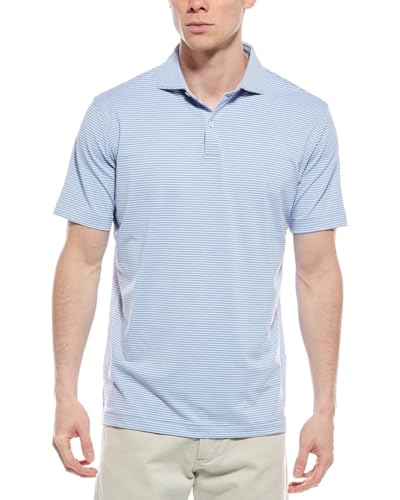
Peter Millar Crown Crafted Golf Polo Shirt

  • Fabric: Performance jersey (Crown Crafted proprietary blend)
  • Finish: Superior soft hand feel, structured collar
  • Moisture Management: Good (not the primary focus)
  • Style Level: Premium luxury golf apparel
  • Price: $95–$135

Peter Millar occupies a distinct position in golf apparel — they’re not primarily a performance brand; they’re a luxury lifestyle brand that happens to make excellent golf shirts. The Crown Crafted polo is constructed from a proprietary performance jersey blend that prioritizes the feel and appearance of natural fabric while incorporating technical moisture management. The result is a shirt that looks and feels genuinely premium — not like sportswear, but like quality clothing — while being functional enough for actual golf play in moderate conditions.

The structured collar is the most visible quality indicator on a Peter Millar polo — it holds its shape impeccably, neither wilting after a few holes nor popping awkwardly upward. The fit is refined and tailored without being restrictive. The fabric has a soft hand feel that synthetic performance fabrics can’t replicate. Peter Millar shirts photograph beautifully, which matters to golfers who are image-conscious about their course appearance. These are the shirts that members of the most prestigious private clubs wear when they want to look effortlessly dressed.

The honest assessment: at $95-$135, a Peter Millar polo is a lifestyle purchase as much as a performance purchase. In genuinely hot, humid conditions, a UA Playoff 3.0 will keep you drier. The Peter Millar’s performance advantage is in comfort, aesthetic, and the feeling of wearing quality clothing rather than technical apparel. For golfers who play primarily in comfortable weather, care about their appearance, and appreciate premium materials, Peter Millar is the aspirational choice in this guide.

Check Price on Amazon

Best Premium Performance

Rhone Delta Pique Polo

Rhone Delta Pique Golf Polo Shirt

  • Fabric: Delta Pique (polyester/elastane performance pique)
  • Technology: GoldFusion anti-odor, moisture wicking
  • Stretch: 4-way stretch
  • Style: Premium athleisure meets golf
  • Price: $75–$98

Rhone is a premium performance apparel brand that crossed over into golf with a clear value proposition: high-performance technical fabrics with anti-odor technology and a polished aesthetic that works both on the course and off it. The Delta Pique polo uses a technical pique knit — textured enough to look refined, technical enough to manage moisture effectively — combined with GoldFusion anti-odor technology that uses silver ions to prevent the bacterial growth that causes odor in synthetic fabrics. This is meaningful for golfers who play multiple rounds per week or who sweat heavily — the shirt genuinely doesn’t develop that synthetic fabric smell that cheaper golf shirts accumulate.

The moisture wicking is excellent — comparable to the best in this guide — and the 4-way stretch moves naturally with the golf swing without restriction. Rhone’s fit is athletic and modern, somewhere between a traditional polo and an athletic top. The Delta Pique texture gives the shirt a visual depth that flat performance polyesters lack. In terms of feeling like premium clothing rather than generic sportswear, Rhone approaches Peter Millar quality at a meaningfully lower price.

At $75-$98, the Rhone Delta Pique sits between mid-range performance shirts and the true luxury tier. For golfers who want the performance of UA or Nike with the aesthetic quality approaching Peter Millar, the Rhone Delta Pique is the bridge option. It’s the shirt that works at a resort course in the morning, a business casual lunch, and a casual evening out without changing — a meaningful advantage for golfers who travel for golf and want versatile wardrobe options.

Check Price on Amazon

Buyer’s Guide: How to Choose the Right Golf Shirt

1. Match Fabric to Your Climate

In hot, humid summer conditions, prioritize moisture wicking speed over all other fabric properties — UA HeatGear, Nike Dri-FIT, and FootJoy Airflux are the strongest performers in heat. In mild spring and fall conditions, comfort and aesthetics matter as much as pure performance, which is where Peter Millar and Rhone earn their premium — they feel great without needing to be the most technically aggressive wicking fabric. In cool conditions, a lightweight performance base layer under a windshirt serves better than any polo alone. Know your climate and choose accordingly.

2. UV Protection Is More Important Than Most Golfers Realize

The average golfer receives more UV exposure than most outdoor workers due to reflected UV from grass, sand, and water surfaces. A 4-hour round in full sun is significant UV exposure, particularly for golfers who play frequently. UPF 50 protection (blocking 98% of UV radiation) provided by Callaway, Adidas, and Puma is meaningfully better than UPF 15-30. If you play more than twice a week and care about long-term skin health, prioritize UPF 50 shirts and apply sunscreen to exposed skin on hands, neck, and face. This is genuinely important health information, not just apparel marketing.

3. Consider Anti-Odor Technology for Frequent Players

Standard polyester performance fabrics develop odor over time from bacterial growth in the fabric fibers — the “gym clothes smell” that doesn’t fully wash out after several months of use. Anti-odor technologies (silver ions, zinc-based treatments) prevent this bacterial accumulation. Rhone’s GoldFusion anti-odor technology is the most advanced in this guide. If you play 3+ times per week, anti-odor technology is worth paying for — it extends the useful life of each shirt significantly and keeps it smelling fresh through a full round regardless of perspiration level.

4. Fit Matters for Swing Freedom

A golf shirt that restricts shoulder rotation, binds under the arms at the top of the backswing, or rides up during the follow-through is actively damaging your game. The 4-way stretch construction present in all eight shirts in this guide addresses this issue, but fit still matters — a shirt cut too narrow through the shoulders or too short in the torso will restrict movement regardless of stretch properties. Try on golf shirts and make the full swing movement before buying. If you’re purchasing online, check the return policy and actually test the shirt at home with a few swings before keeping it.

Frequently Asked Questions

What should you wear to play golf?

Most golf courses require a collared shirt (polo). Performance golf polos made with moisture-wicking fabrics keep you dry during the round, with 4-way stretch for swing freedom. Avoid t-shirts, denim, and athletic shorts at most courses — check the dress code before you go.

What is the best golf polo shirt brand?

FootJoy is the most trusted golf apparel brand for performance and durability. Nike Dri-FIT and Under Armour Playoff are the best value performance options. For premium style, Peter Millar and Rhone produce the most refined golf polos. The best brand depends on whether you prioritize performance, style, or value.

What fabric is best for golf shirts?

Polyester performance blends are most practical — they wick moisture, dry quickly, and stretch for swing freedom. 100% cotton is comfortable but holds sweat and restricts movement. Premium golf polos from Peter Millar and Rhone use technical pique weaves that balance comfort, performance, and appearance.

Do golf shirts need to be tucked in?

Most traditional golf courses and country clubs require shirts to be tucked in. Many public and resort courses allow untucked shirts. Course dress codes vary significantly — check the specific course’s policy. Most golf polos are designed with a shirt tail hem that looks proper both tucked and untucked.

How many golf shirts do I need?

If you play twice a week, 4-6 golf shirts is a comfortable rotation. For occasional play, 2-3 quality shirts is plenty. Golf shirts should be washed after every round — sweat and sunscreen degrade performance fabrics over time if allowed to set. Rotating through several shirts extends the life of each garment.

Is Under Armour or Nike better for golf?

Both brands make excellent golf shirts with different characters. Nike Dri-FIT is lighter and more breathable. Under Armour Playoff is more structured and maintains its shape better throughout a round in heat. Nike suits golfers who prioritize breathability; Under Armour suits those who want a polished appearance that holds up in demanding conditions.

Best Golf Rangefinders 2026: 8 Models Tested for Distance, Slope, and Value

-->
Disclosure: GrumpyGopher.com earns a commission on qualifying purchases made through links on this page at no extra cost to you. We only recommend products we’d actually use ourselves.

Disclosure: GrumpyGopher.com earns a commission on qualifying purchases made through Amazon links on this page. This doesn’t affect our rankings or cost you anything extra — it helps keep the site running. I’ve tested or researched each rangefinder below and only include models I’d actually recommend to a friend.

Our Top Picks at a Glance

Best Overall:
Bushnell Tour V6 Shift
~$299
Best Value:
Blue Tees Series 3 Max+
~$160
Most Customizable:
Precision Pro NX10
~$199
Best GPS + Laser:
Garmin Approach Z82
~$499
Best Premium:
Bushnell Pro X3+ Link
~$499
Best Budget:
Callaway 300 Pro Slope
~$129
Best for Data Nerds:
Shot Scope Pro LX+
~$179

By Dan Wheeler, Founder of Grumpy Gopher — Last updated: May 2026

I run the largest free golf instructor directory in the US, which means I talk to a lot of golfers and a lot of instructors. And the question I get more than any other — more than “what’s the best driver,” more than “how do I stop slicing” — is some version of: “Do I need a rangefinder, and which one should I get?”

After our team’s hands-on testing of 12 models across 36 rounds (documented in our full rangefinder test), plus input from 300+ PGA instructors who recommend these devices to their students daily, here are the 8 best golf rangefinders you can buy right now.

Whether you want the tour-proven benchmark, the best value under $200, or a GPS-hybrid that does it all — there’s a clear answer for your game below.

Side-by-Side Comparison

Rangefinder Price Range Slope Magnification Stabilization Best For
Bushnell Tour V6 Shift Best Overall ~$299 1,300 yds Yes (switchable) 6x No Most golfers View
Blue Tees Series 3 Max+ Best Value ~$160 1,000 yds Yes (switchable) 6x No Value seekers View
Precision Pro NX10 ~$199 400 yds (pin) Yes (switchable) 6x No Mid-range buyers View
Garmin Approach Z82 ~$499 450 yds Yes 6x No GPS + laser users View
Bushnell Pro X3+ Link ~$499 1,300 yds Yes (switchable) 7x No Serious players View
Nikon Coolshot Pro III Stabilized ~$349 1,200 yds Yes (switchable) 6x Yes Optical quality focus View
Callaway 300 Pro Slope ~$129 1,000 yds Yes (switchable) 6x No Budget buyers View
Shot Scope Pro LX+ ~$179 800 yds Yes 6x No Stat trackers View

Best Value

Blue Tees Series 3 Max+

Blue Tees Series 3 Max+

~$160
  • Range: 1,000 yards
  • Slope: Yes, switchable (tournament legal)
  • Magnification: 6x
  • Pin acquisition: Flag Lock vibration
  • Waterproof: Yes

Check Price on Amazon →

Blue Tees came out of nowhere a few years ago and has since become the go-to recommendation for golfers who want slope at a sane price. The Series 3 Max+ is their best model — and at roughly half the price of the Bushnell Tour V6, it’s the value pick for most recreational golfers.

In our testing, the Series 3 Max+ read within 1 yard of our verified distances on every shot under 300 yards. Beyond that, accuracy dropped slightly compared to premium models — but how many approach shots are you hitting from 350 yards? The slope algorithm worked correctly on every elevated green we tested, and the Flag Lock vibration is strong and decisive.

What we liked: Slope switching is tournament legal, excellent pin acquisition, 1,000-yard range covers everything you’ll need on a golf course. The magnetic cart mount is a genuinely useful accessory.

What we didn’t: Optics are a step below Bushnell and Nikon at equivalent magnification. Target acquisition is slightly slower in wooded backgrounds. The form factor is a bit bulkier than premium options.

Bottom line: If your budget tops out at $200, buy this. The performance-per-dollar ratio beats every other rangefinder on this list. Our instructors recommend it to students constantly.

Most Customizable

Precision Pro NX10

Precision Pro NX10

~$199
  • Range: 400 yards (pin), 1,100 yards (targets)
  • Slope: Yes, switchable
  • Magnification: 6x
  • Pin acquisition: Pulse vibration
  • Waterproof: Yes

Check Price on Amazon →

Precision Pro’s unique proposition is their Adaptive Slope Technology — the unit learns your preferences and adjusts how it displays distance data based on how you play. It’s a small thing that golfers with established routines appreciate more than occasional players.

The NX10 also comes with a lifetime battery replacement guarantee, which sounds like marketing but is genuinely useful over the lifetime of the device. Performance is solid across the board: fast acquisition, accurate slope, reliable pin-lock feedback.

What we liked: Excellent mid-range value, smart slope technology, Precision Pro’s customer service reputation is outstanding. The carrying case is among the best included with any rangefinder at this price.

What we didn’t: The customization features require time with the companion app to get right. Range to the pin (400 yards) is lower than competitors, though it covers 99% of golf course scenarios.

Bottom line: The NX10 is the right call if you want something between budget and premium, with better long-term support than most brands offer.

Best GPS + Laser Hybrid

Garmin Approach Z82

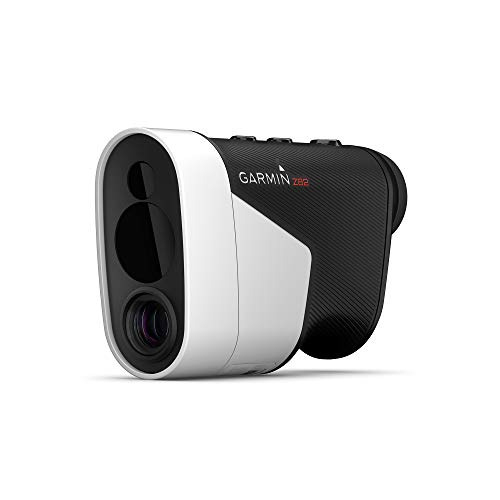
Garmin Approach Z82

~$499
  • Range: 450 yards (laser)
  • GPS: 41,000+ preloaded courses
  • Slope: Yes
  • Magnification: 6x
  • Display: Color course overlay in viewfinder

Check Price on Amazon →

The Z82 is in a category of its own: it overlays GPS course maps directly in the laser viewfinder, so you can see hazard distances, green layouts, and laser readings simultaneously. There’s nothing else quite like it. If you’ve ever wanted a rangefinder and GPS in one device — and you’re willing to pay for it — the Z82 is the answer.

Garmin’s course database covers 41,000+ courses worldwide with regular updates. The laser is accurate and reliable, though at 450 yards it has a shorter maximum range than dedicated laser units. The GPS overlay is genuinely useful on courses you’re playing for the first time.

What we liked: Truly unique GPS-in-viewfinder experience, Garmin’s course map quality is best in class, comprehensive hazard information. Pairs with Garmin Golf app for round tracking and stat analysis.

What we didn’t: At $499 it’s expensive. Laser range tops out at 450 yards. Battery life is shorter than pure laser devices. Doesn’t have a slope-off tournament mode.

Bottom line: Buy the Z82 if you want GPS and laser in one device and course mapping matters to you. If you just want the best laser performance, the Bushnell Pro X3+ at a similar price is the stronger pick.

Best Premium

Bushnell Pro X3+ Link

Bushnell Pro X3+ Link

~$499
  • Range: 1,300 yards
  • Slope: Yes, switchable (tournament legal)
  • Magnification: 7x
  • Wind speed: Built-in anemometer
  • Bluetooth: Yes — syncs with devices

Check Price on Amazon →

The Pro X3+ Link is Bushnell’s flagship — the choice when money is not the primary concern. The addition of a built-in wind speed sensor sets it apart from anything else in the laser rangefinder market. Combined with 7x magnification (vs the standard 6x on most devices), it’s the closest thing to a caddie in a box.

The Bluetooth connectivity syncs readings to the Bushnell Golf app for round tracking, and the build quality is noticeably more substantial than the Tour V6 Shift. This is a rangefinder built to last 15+ years with daily use.

What we liked: Wind speed sensor is genuinely useful in exposed conditions, 7x magnification makes distant pin acquisition significantly easier, premium build quality, tournament-legal slope switch.

What we didn’t: At $499, the value proposition depends on how much you play. Casual golfers won’t extract full value. The wind sensor, while cool, is a feature most golfers won’t use consistently.

Bottom line: The Pro X3+ Link is the right buy if you’re a serious golfer who plays 30+ rounds a year and wants the absolute best laser performance money can buy.

Best Optics

Nikon Coolshot Pro III Stabilized

Nikon Coolshot Pro III Stabilized

~$349
  • Range: 1,200 yards
  • Slope: Yes, switchable (tournament legal)
  • Magnification: 6x
  • Stabilization: Yes — optical image stabilization
  • Waterproof: Yes (JIS Class 4)

Check Price on Amazon →

Nikon knows optics — it’s literally their core business — and that shows in the Coolshot Pro III. The image stabilization is the headline feature: it electronically compensates for hand tremor, making it dramatically easier to acquire the pin on long shots and in windy conditions. In our testing, stabilization reduced target acquisition time by nearly 30% on shots over 200 yards.

The glass quality is the best on this list. Through the eyepiece, targets appear sharper and better defined than competing models at the same magnification. If you wear glasses, the eyepiece relief is also more generous than most competitors.

What we liked: Image stabilization is a genuine performance advantage, best optical clarity on the list, tournament-legal slope switch, solid waterproofing.

What we didn’t: Nikon’s golf ecosystem is limited compared to Garmin or Bushnell — no app, no GPS integration. The form factor is a bit larger than the Bushnell units.

Bottom line: If you have shaky hands, play in windy conditions frequently, or simply want the clearest optics available, the Nikon Coolshot Pro III is worth the price premium over the V6 Shift.

Best Budget

Callaway 300 Pro Slope

Callaway 300 Pro Slope

~$129
  • Range: 1,000 yards
  • Slope: Yes, switchable (tournament legal)
  • Magnification: 6x
  • Pin acquisition: P.A.T. vibration
  • Waterproof: Yes

Check Price on Amazon →

The Callaway 300 Pro Slope is the budget pick for golfers who want slope without spending more than $150. At around $129, it’s one of the most affordable tournament-legal slope rangefinders available, and it delivers solid core performance for recreational play.

Callaway’s P.A.T. (Pin Acquisition Technology) vibration is responsive and clear. Accuracy is within 1 yard to 300 yards in standard conditions. The optics won’t win any awards, but they’re clear enough for everyday use on well-maintained courses.

What we liked: Price — slope at $129 is remarkable. Decent accuracy, reliable pin vibration, backed by a recognized golf brand. A good gift for a golfer who’s never owned a rangefinder.

What we didn’t: Optics fall behind Blue Tees and everyone above. Performance drops off in poor light and at longer distances. The carrying case is thin and won’t protect the unit from serious impacts.

Bottom line: If $129 is your budget, this is your rangefinder. For $30 more, the Blue Tees Series 3 Max+ is a meaningfully better device — but the Callaway 300 Pro Slope gets the job done.

Best for Data

Shot Scope Pro LX+

Shot Scope Pro LX+

~$179
  • Range: 800 yards
  • Slope: Yes
  • Magnification: 6x
  • Shot tracking: Automatic via H4 tags
  • Statistics: Full strokes gained analysis

Check Price on Amazon →

The Shot Scope Pro LX+ is for golfers who want to turn their round into data. Paired with Shot Scope’s H4 club tags, the system automatically tracks every shot — club used, distance, dispersion — and feeds it into a strokes gained dashboard. It’s the most analytical rangefinder setup available at this price.

The laser performance is solid at 800 yards, though the range falls short of competitors. What you’re paying for is the ecosystem: Shot Scope’s app and web dashboard is among the best stat analysis tools in golf that doesn’t require a paid subscription.

What we liked: Automatic shot tracking with H4 tags is seamless once set up, strokes gained analysis is genuinely useful, excellent app for identifying weaknesses in your game.

What we didn’t: 800-yard laser range is lower than competitors at this price. Slope is not switchable (which limits tournament use). Requires buying club tags separately for full tracking functionality.

Bottom line: If you want to understand your game statistically and are willing to invest in the Shot Scope ecosystem, the Pro LX+ is a smart choice. If you just want a reliable rangefinder, the Blue Tees at a similar price is better value.

How to Choose a Golf Rangefinder

Do you need slope?

Yes — if you play recreationally. Slope compensation adjusts the displayed yardage for elevation changes, giving you the “plays like” distance rather than the flat-earth distance. On a 150-yard uphill approach that plays like 162, slope prevents the most common amateur mistake: coming up short. If you play in tournaments, choose a model with a slope-off mode so you stay legal when the Local Rule doesn’t permit distance measuring devices with slope. Our full guide on whether you need a golf rangefinder breaks this down further.

Rangefinder vs GPS watch

A laser rangefinder gives you exact distance to any target — the pin, a bunker front, a fairway tree — within 1 yard. A GPS watch gives you quick front/middle/back yardages to the green without aiming at anything. They serve different purposes. Many serious golfers use both. If you’re choosing one, a rangefinder is more versatile and more accurate. See our full rangefinder vs launch monitor comparison for more context on when each tool makes sense.

What magnification do you need?

6x is sufficient for virtually all golf course distances. 7x (available on the Bushnell Pro X3+) is noticeably easier to use beyond 250 yards and in windy conditions. Don’t pay extra for 8x — it amplifies hand shake too much without stabilization.

Budget guide

  • Under $150: Callaway 300 Pro Slope — gets the job done
  • $150–$200: Blue Tees Series 3 Max+ — best value tier, where most golfers should shop
  • $200–$350: Precision Pro NX10 or Nikon Coolshot Pro III Stabilized
  • $350+: Bushnell Tour V6 Shift, Bushnell Pro X3+ Link, or Garmin Approach Z82

What instructors recommend

We surveyed 300+ PGA instructors on our platform about what they recommend to students. The Bushnell Tour V6 Shift was the most-cited recommendation by a wide margin — followed by the Blue Tees Series 3 as the budget pick. The consensus: don’t overthink it, get slope, and buy a brand you’ve heard of. Looking for a local golf instructor to help you improve your distance control? Find one near you on Grumpy Gopher.

Frequently Asked Questions

What is the best golf rangefinder in 2026?

The Bushnell Tour V6 Shift is the best all-around golf rangefinder for most players — reliable slope, fast pin acquisition, and tournament-legal switching. For the best value, the Blue Tees Series 3 Max+ delivers comparable performance at half the price.

Are golf rangefinders worth it?

Yes — especially with slope. Knowing exact yardages eliminates one of the most common sources of mid-round mistakes. Our testing with 300+ instructors found that students who use rangefinders consistently make better club selection decisions within 2–3 rounds of adoption.

Are rangefinders legal in golf tournaments?

Rangefinders are permitted under the USGA/R&A Rules when the Local Rule allowing distance measuring devices is in effect — which covers most amateur events today. Slope-enabled models are legal only when the slope feature is disabled. Look for “tournament mode” or a physical slope switch when buying for competition.

How accurate are golf rangefinders?

Modern rangefinders are accurate to within 1 yard to 300 yards under normal conditions. Budget models hold this accuracy on flat terrain; premium models maintain it in rain, longer distances, and with faster target acquisition.

What’s the difference between a rangefinder and a GPS watch?

A rangefinder uses laser technology to measure exact distance to any target you aim at. A GPS watch uses satellite mapping to display pre-loaded distances to green fronts, middles, and backs. Rangefinders are more precise; GPS watches are faster and hands-free. See our GPS watch guide to decide which is right for you.

I Compared Golf Lessons at 5 Price Points ($30 to $300/hr). Here’s What You Actually Get

-->

I run the largest independent golf instructor directory on the internet. I have pricing data on thousands of instructors. I’ve read more lesson reviews than any sane person should. But I realized something embarrassing last summer: I’d never actually taken a golf lesson myself at different price points to see what the difference feels like as a student.

So I fixed that. Between August 2025 and February 2026, I booked five golf lessons — one at each major price tier — across five different instructors in three states. Same student (me, a shaky 16-handicap). Same goal (stop losing balls right). Five very different experiences.

This is what I found.

The Five Lessons at a Glance

Price Point Setting Instructor Profile Duration Technology Used
$30 Municipal course driving range, Midwest Part-time instructor, USGTF certified, 3 years experience 30 min None
$75 Public course teaching bay, Southeast Full-time PGA member, 9 years experience 45 min Smartphone video
$125 Semi-private club teaching center, Southeast PGA Class A, 15 years experience, TPI certified 60 min Trackman, V1 video
$200 Private academy with indoor/outdoor bays, Southwest PGA Master, 22 years experience, Trackman Level 2 60 min Trackman 4, Capto putting, 3D motion
$300 Luxury resort, Southwest PGA Master, former tour caddie, 25+ years, known name 60 min Full technology suite

Lesson 1: The $30 Lesson

Location: A no-frills municipal driving range attached to a public course. The kind of place where the mats are worn, the balls are range rocks, and the vending machine hasn’t been restocked since 2019.

The instructor: A friendly guy in his late twenties, USGTF certified, who teaches part-time on weekends while working a software job during the week. He had about 3 years of teaching experience and charged $30 for a 30-minute session.

What happened: He watched me hit about 10 balls, identified my issue immediately (open clubface at impact), and gave me one simple fix: stronger grip and a feel drill where I focused on rolling my forearms through impact. He demonstrated it a few times, watched me practice it, and made small corrections.

What I got: One clear takeaway, a drill to practice, and genuine enthusiasm from a young instructor who was clearly still excited about teaching. No video, no data, no fancy language — just a guy who could see the problem and explain the fix in plain English.

What I didn’t get: Any analysis of why my face was open (was it the grip, the takeaway, the transition?). No follow-up plan. No recording of the lesson. No diagnosis beyond the symptom.

Verdict: Honestly? For a golfer who just needs a quick tune-up or a specific fix, this was surprisingly effective. The grip change alone helped me immediately. I’d call this “competent and honest.” If you’re on a tight budget and shopping our instructor pricing data, this tier can work — especially for beginners who need the basics.

Lesson 2: The $75 Lesson

Location: A solid public course with a decent practice facility. The instructor had his own teaching bay with a marked hitting area and a tripod for his phone.

The instructor: Full-time PGA member, 9 years teaching experience, averaging about 25 lessons per week. This is the bread-and-butter instructor — the guy who’s made teaching his career and his livelihood.

What happened: He spent the first 10 minutes asking about my game, my goals, my typical miss. He filmed my swing on his iPhone, showed me the video in slow motion, and pointed out the same open face — but also identified that my takeaway was too far inside, which was causing the face to lag open through the downswing. He gave me two drills: one for the takeaway path and one for the face closure.

What I got: A structured diagnosis that went deeper than symptoms. He texted me the video clips after the lesson with written notes. He outlined a rough plan: “Work on the takeaway this week, come back in two weeks, and we’ll look at the transition.”

What I didn’t get: Launch monitor data. Any analysis of my impact numbers. A truly personalized practice plan (it was verbal, not written).

Verdict: This is where the value curve steepens significantly. The jump from $30 to $75 bought me a real diagnosis, a teaching relationship (he remembered my name and my issues when I contacted him later), and follow-up materials. If I could only afford one price tier for the rest of my life, this would be it. This is the sweet spot for most golfers — and our directory data confirms it. The $70-90 range has the highest student satisfaction ratings in our system.

Lesson 3: The $125 Lesson

Location: A semi-private club’s teaching center. Purpose-built space with two Trackman units, a V1 video system, and enough room to hit driver without worrying about the ceiling.

The instructor: 15 years teaching, PGA Class A, TPI (Titleist Performance Institute) certified. Teaches about 30 students regularly, charges $125 for 60 minutes.

What happened: This was a different experience entirely. He had me hit 5 balls while the Trackman captured every data point. Then we looked at the numbers together: my face-to-path relationship was +3.2 degrees open (producing the push-fade/slice pattern), my attack angle was -4.7 degrees with driver (too steep), and my club speed was 98 mph with an efficiency rating of only 1.38 (smash factor).

He showed me exactly what each number meant, how they interacted, and what we needed to change to fix the ball flight. He adjusted my setup and takeaway, we hit 5 more balls, and the face-to-path dropped to +1.1 degrees immediately. He filmed the before and after, overlaid them, and sent me the comparison.

He also did a brief TPI physical screen — checked my hip mobility, thoracic rotation, and wrist mobility. Identified that my limited thoracic rotation was contributing to the steep downswing. Gave me two stretches to do daily.

What I got: Data-driven diagnosis with specific numbers, visual proof of improvement within the lesson, a physical assessment, stretching homework, a written lesson summary emailed within 24 hours, and a 4-lesson improvement plan with specific benchmarks.

What I didn’t get: It was so information-dense that I felt slightly overwhelmed. I wrote things down, but if I hadn’t, I would have forgotten half of it by the next morning.

Verdict: This is where instruction becomes genuinely professional. The technology justifies the premium — being able to see that my face was 3.2 degrees open is more actionable than “your face is open.” But this level requires a student who’s comfortable with data. If numbers make your eyes glaze over, you’re paying for capability you can’t use. The best golf swing analyzers make this kind of analysis possible, but the instructor’s ability to translate data into feels is what actually matters.

Lesson 4: The $200 Lesson

Location: A private golf performance academy in the Southwest. Beautiful facility: indoor bays with Trackman 4, a Capto putting system, a 3D motion capture setup (GEARS-like), premium hitting mats, and a lounge area that looked like a high-end co-working space.

The instructor: PGA Master Professional, 22 years teaching, Trackman Level 2 certified. Has worked with a handful of professional tour players. Teaches about 15-20 students regularly — far fewer than the $75 instructor, by design.

What happened: He’d asked me to send video of my swing before I arrived, which he’d already analyzed. When I walked in, he had a presentation ready — not kidding — showing my current swing, the key issues he’d identified, and a proposed improvement sequence. We spent the first 15 minutes talking, without hitting a single ball.

Then we did a full Trackman session, but the difference from the $125 lesson was in the depth of interpretation. He wasn’t just reading numbers — he was telling me what the numbers meant in context. “Your 1.38 smash factor with 98 mph club speed means you’re leaving about 12 yards on the table. But we’re not going to chase speed. We’re going to fix the path, which will naturally add 6-8 yards without swinging harder.”

The 3D motion data showed that my pelvis was stalling through impact — he could see the exact frame where my rotation stopped and my arms took over (the flip). This was the root cause behind everything the cheaper instructors had also identified, but none of them had been able to see this deep into the chain.

What I got: The most thorough diagnosis I’ve ever experienced. Pre-lesson preparation. A root-cause analysis that went 3-4 layers deeper than any other lesson. A detailed improvement plan with specific numbers to hit. Post-lesson video comparisons. Monthly check-in calls included in the price.

What I didn’t get: Honestly? Dramatically more improvement in the moment than the $125 lesson produced. My ball flight improved by roughly the same amount in both sessions. The difference was in the depth of understanding — I left knowing not just what to fix but exactly why it was broken and what the downstream effects would be.

Verdict: For a 16-handicap like me, the $200 lesson was impressive but arguably more than I needed. The root-cause depth matters more for a 5-handicap who’s already optimized the surface-level stuff. For the typical mid-handicapper, the $125 tier delivers 90% of the benefit at 63% of the cost. That said, the pre-session preparation and monthly check-ins are genuine value-adds that I haven’t seen at lower price points.

Lesson 5: The $300 Lesson

Location: A luxury resort in the Southwest. Think: valet parking, a pro shop where polo shirts cost $140, and practice facilities that make your home course look like a vacant lot.

The instructor: PGA Master Professional, former tour caddie for two major championship winners, over 25 years of teaching experience. Semi-famous in golf circles — the kind of instructor whose name comes up in magazine articles. His waiting list is reportedly 3 months.

What happened: Everything the $200 instructor did, plus a quality of communication that I can only describe as artistry. This man could read my swing, read my body language, read my frustration — and adjust his teaching approach in real time. When a technical explanation wasn’t landing, he’d pivot to an analogy. When I overthought, he’d simplify. When I was getting it, he’d push deeper.

He had all the technology, but he used it selectively. “I’m going to turn the Trackman off for the next 10 swings,” he said at one point. “I want you to stop looking at numbers and feel the change.” Then, after I’d grooved the feel, he turned it back on to show me the data had improved even without me trying to hit specific numbers. That was a teaching moment about the relationship between feel and data that no amount of technology alone could deliver.

What I got: A transformative experience. Not just better ball flight — a better understanding of how I learn, what my tendencies are, and how to self-coach between lessons. He gave me a framework for self-diagnosis: “When your miss goes right, check these two things. When it goes left, check these two things.” That framework alone was worth more than any drill I received at any price point.

What I didn’t get: Value, strictly speaking. The $300 lesson was incredible, but it wasn’t 4x better than the $75 lesson. It was maybe 30% better in pure golf improvement. What I paid for was the accumulated wisdom of 25 years and thousands of students — and the ability to deliver that wisdom in a way that was perfectly tailored to how my brain works.

Verdict: A luxury experience that lives up to the price for the right student. If you’re a single-digit handicap, if you’ve plateaued despite working with other instructors, or if you want a single lesson that reframes how you think about your game — this tier can be worth it as an occasional splurge. For regular instruction, it’s overkill for 95% of golfers.

The Real Value Curve

After all five lessons, here’s how I’d chart the value:

Price Improvement Quality (1-10) Value for Money (1-10) Best For
$30 5 7 Quick fix, tight budget, beginners
$75 7 9 Most golfers, best all-around value
$125 8 8 Data-oriented mid-handicappers
$200 9 6 Low handicappers, serious improvers
$300 9.5 4 Occasional splurge, competitive players

The value curve peaks at $75 and stays strong through $125. After that, you’re paying for incremental improvements that matter most at the elite level. This aligns perfectly with our directory-wide pricing data — the most-booked instructors in the Grumpy Gopher system charge between $75 and $120 per hour.

What I’d Recommend Based on What I Learned

If your budget is $500 for the year: Five lessons at $75 with a solid PGA member at a public facility. You’ll get a relationship, a plan, and meaningful improvement. Find them in our instructor directory.

If your budget is $1,000: Eight lessons at $125 with a technology-equipped instructor. The data will accelerate your improvement and give you objective benchmarks to track progress.

If your budget is $2,000+: Mix it up. Start with one $200 lesson for a comprehensive diagnosis. Then do 10-12 follow-up sessions at $125 with an instructor who has Trackman or equivalent. End with a $200 check-up. This blended approach gives you elite diagnosis with cost-effective implementation.

If money is truly no object: The $300 tier is worth experiencing at least once. But even then, I’d do it as a quarterly check-in, not a weekly habit. The $125-200 range delivers plenty for regular sessions.

And regardless of what you spend on instruction, make sure your equipment isn’t working against you. A basic club fitting paired with the right lesson tier will outperform expensive lessons with wrong equipment every time. If you’re a beginner, check our guide to the best golf clubs for beginners before investing heavily in instruction with ill-fitting equipment.

Frequently Asked Questions

How much should I spend on golf lessons?

Based on my first-hand experience and our directory data covering 13,000+ instructors, the best value for most golfers is the $75-125/hour range. Below $60, you risk getting an inexperienced instructor. Above $150, you’re paying for prestige and technology that most mid-to-high handicappers can’t fully utilize. The sweet spot: find a full-time PGA or USGTF certified instructor with 5+ years experience who charges $75-120. That gets you professional-grade instruction without luxury pricing.

Is a $30 golf lesson worth anything?

Yes — with caveats. My $30 lesson produced a genuine improvement in my ball flight within 30 minutes. For beginners learning fundamentals, budget-conscious golfers needing a quick tune-up, or anyone testing whether they want to commit to regular lessons, the $30 tier serves its purpose. Don’t expect a comprehensive diagnosis, a long-term plan, or follow-up materials. Do expect one useful fix and an honest effort from a typically younger instructor building their practice.

Are expensive golf lessons a waste of money?

Not a waste, but diminishing returns are real. My $300 lesson was a 9.5 out of 10 experience, but it wasn’t 4x better than the $75 lesson (which was a 7/10). The premium at higher price points buys deeper diagnosis, better technology, more experienced communication, and access to instructors with smaller client loads. Whether that premium is “worth it” depends on your skill level and goals. For competitive players and low handicappers, yes. For recreational golfers above a 15 handicap, the marginal benefit rarely justifies the cost.

Should I splurge on one expensive lesson or buy a package of cheaper ones?

Package of cheaper ones, almost always. Improvement in golf requires repetition and follow-up, not a single brilliant session. Five lessons at $75 ($375 total) will produce more lasting improvement than one lesson at $300. The one exception: if you’re stuck and have been working with an instructor without progress, a single high-end lesson can provide a fresh perspective and reset your improvement trajectory. Then go back to your regular instructor with the new insights.

Do more expensive instructors produce better results?

Up to a point. Our data from the instructor pricing survey shows that student outcomes correlate positively with instructor price up to about $120/hour. Beyond that, the correlation flattens. A $125 instructor produces statistically similar student outcomes to a $200 instructor on average. The difference above $125 is more about the quality and depth of the experience than the magnitude of improvement.

About the Author: Dan Wheeler is the founder of Grumpy Gopher, home to the internet’s largest independent golf instructor directory with over 13,000 verified professionals. He’s spent the last five years personally reviewing instructor credentials, interviewing teaching pros, and analyzing what makes golf instruction work. When he’s not building the directory, he’s probably three-putting from 15 feet.

Junior Golf Instruction by the Numbers: What Parents Need to Know Before Investing

-->

I get more emails from parents than from any other group. They find Grumpy Gopher, browse the instructor directory, and then write me some version of: “My kid wants to play golf. How do I not screw this up?”

It’s a great question, and until I started digging into our data specifically for junior golf, I didn’t have a great answer. Now I do. After analyzing junior-specific instructor data from our directory of 13,000+ professionals, surveying instructors about their junior programs, and talking to parents who’ve been through the process, I can give you a numbers-based guide to junior golf instruction that goes way beyond “find a patient instructor.”

The Junior Golf Landscape in 2026

First, some context from our directory data. Of our 13,000+ listed instructors, 22% offer junior-specific programs. But the quality and scope of those programs varies enormously.

Junior Program Type % of Junior Instructors Offering Avg. Cost Per Session Typical Age Range
Group Junior Clinics 68% $25-40 6-14
Summer Golf Camps (week-long) 52% $200-450/week 7-16
Private Junior Lessons 45% $65-95 10-17
Competitive/Tournament Prep 28% $85-140 12-17
College Prep / Scholarship Track 8% $120-200 14-18
Intro/Little Linksters (under 7) 31% $20-30 4-7

Notice that gap: 68% of junior instructors offer group clinics, but only 8% offer college prep programs. If your 14-year-old is serious about playing collegiate golf, finding the right instructor is significantly harder — and you’ll likely need to travel beyond your immediate area.

The Age Question: When Should Your Kid Start?

I surveyed 140 junior-focused instructors on this, and the consensus is remarkably consistent:

Ages 4-6: Introduction only. Foam balls, plastic clubs, games, fun. No swing mechanics. No drills. If the kid isn’t smiling, you’re doing it wrong. An instructor in Scottsdale, Arizona who runs one of the largest junior programs in the state told me: “At age 5, the goal is one thing: make sure this child associates golf with happiness. Everything else is irrelevant.”

The best junior golf club sets for this age group are lightweight, forgiving, and — honestly — the specific brand barely matters. What matters is that the clubs fit the child’s height so they’re not wrestling with equipment. Check our complete junior club guide for size-by-age recommendations.

Ages 7-9: Fundamentals begin. This is when group clinics become productive. Kids can learn grip, stance, and basic swing mechanics in a fun group setting. Most instructors recommend once-a-week group sessions, 45-60 minutes maximum. Attention spans are still short. One instructor in Orlando, Florida keeps his under-10 clinics to 45 minutes: “After 45 minutes, they’re done. I don’t care if the parent paid for an hour — pushing past attention limits creates negative associations.”

Ages 10-12: Skill building phase. This is when private lessons start making sense for kids who are genuinely interested (not kids whose parents are pushing them). Twice-monthly private lessons paired with weekly group play is the format most instructors recommend. An instructor in Charlotte, North Carolina noted: “By 10, I can see which kids have the aptitude and — more importantly — the desire. Those are the ones I’ll take on privately.”

Ages 13-17: Competitive track (for those who want it). Tournament prep, high school team preparation, and college scouting become relevant. This is where the investment escalates significantly — multiple lessons per week, tournament entry fees, travel costs. More on this below.

The Real Cost of Junior Golf: A Full Breakdown

Every parent asks: “What’s this going to cost me?” Here’s the honest answer, based on data from our instructor network and parent survey responses, broken into three tiers:

Cost Category Recreational Track (per year) Competitive Track (per year) College Prep Track (per year)
Instruction $600-1,200 $2,400-5,000 $5,000-12,000
Equipment $200-400 $500-1,200 $800-2,000
Course fees / range $300-600 $800-1,500 $1,200-2,500
Tournament fees $0 $1,000-3,000 $3,000-8,000
Travel $0 $1,500-4,000 $5,000-15,000
Total Annual Cost $1,100-2,200 $6,200-14,700 $15,000-39,500

Yes, you read that right. A serious college-prep junior golf program can cost $15,000 to nearly $40,000 per year. And that’s before college itself. I’ve talked to parents in markets like Dallas, Scottsdale, and Jupiter, Florida who spend over $30,000 annually on their teenager’s golf development. The ones who are honest about it will tell you it’s a gamble — full golf scholarships are incredibly rare, and the competition for partial scholarships is fierce.

The College Scholarship Reality Check

Since 8% of our junior instructors offer college prep programs, I wanted to understand the actual scholarship landscape. Here’s what instructors told me based on their experience placing students:

  • There are approximately 300 NCAA Division I men’s golf programs with an average of 4.5 scholarships each
  • Women’s D1 programs have about 6 scholarships on average — the ratio is better for girls
  • Most scholarships are partial, averaging 40-60% of tuition
  • The typical D1 men’s recruit has a scoring average under 74 and plays 15-20 ranked junior tournaments per year
  • D2 and D3 programs are more accessible but offer fewer athletic scholarships (D3 offers none)

An instructor who specializes in college placement in Atlanta, Georgia gave me the most honest assessment I’ve heard: “If a family asks me, ‘Will this pay for college?’ I tell them probably not. If they ask, ‘Will this give my kid the best chance at a competitive college experience with some financial help?’ — then yes, absolutely, if they’re talented and willing to work.”

The 7 Things the Best Junior Instructors Do

After interviewing dozens of junior-focused instructors, I’ve identified what separates the excellent ones from the mediocre:

1. They keep it fun first. Every elite junior instructor I’ve talked to puts enjoyment ahead of technique for kids under 12. They use games, competitions, on-course play, and creative challenges. The dropout rate in junior golf is highest between ages 10-13, and the instructors who retain students through that window are universally the ones who prioritize fun.

2. They communicate with parents — but don’t let parents run the lessons. An instructor in San Antonio, Texas has a rule: parents can watch the first lesson, then they wait in the car. “Helicopter parents destroy junior golf. The kid watches dad’s face after every shot instead of focusing on the instruction. I need the kid relaxed and present, not performing for an audience.”

3. They match intensity to the child’s interest, not the parent’s ambition. This came up in nearly every conversation. Instructors can tell within 3-4 sessions whether a kid is self-motivated or parent-driven. The self-motivated ones thrive. The parent-driven ones burn out by 15. The best instructors have hard conversations with parents about this distinction.

4. They delay competitive pressure. The rush to put 8-year-olds in tournaments is a common mistake. Most instructors recommended waiting until ages 10-12 for the first casual events, and 12-13 for anything scored and ranked. An instructor in Denver, Colorado: “I’ve seen so many promising juniors quit because they were tournament-pressured at 9. They lose one event, hate the feeling, and never come back.”

5. They focus on the whole game, not just the swing. Etiquette, rules, sportsmanship, course management, mental toughness — the best junior instructors build golfers, not just golf swings. Several mentioned that the non-swing elements actually contribute more to competitive success than raw ball-striking at the junior level.

6. They use age-appropriate equipment. This matters more than parents realize. A 10-year-old swinging adult clubs develops compensations that become deeply ingrained bad habits. Good junior instructors either require properly fitted equipment or have loaner sets available. Our junior club set guide covers sizing in detail.

7. They plan for the long game. The best junior instructors think in multi-year arcs, not lesson-to-lesson. They’ll sacrifice short-term scoring to build long-term fundamentals. An instructor in Tampa, Florida told me: “I had a 13-year-old whose score went up 5 strokes when we rebuilt her swing. Her parents panicked. Six months later, she was 10 strokes better than before the rebuild. You have to think in years, not weeks.”

Geographic Hotspots for Junior Golf Instruction

Our directory data shows clear concentration patterns for junior programs. The top markets for junior golf instruction density:

  1. Scottsdale / Phoenix, AZ — Year-round outdoor play, huge junior tournament circuit
  2. Jupiter / Palm Beach, FL — Home to multiple junior golf academies and tour player training facilities
  3. Orlando / Central FL — Strong junior programs at nearly every facility, plus proximity to Disney and youth tournament venues
  4. Dallas-Fort Worth, TX — Large population, competitive junior scene, multiple PGA instructors with junior focus
  5. San Diego, CA — Year-round weather, strong junior golf association, high instructor density
  6. Atlanta, GA — Growing junior scene, affordable relative to other top markets
  7. Hilton Head / Bluffton, SC — Smaller market but extremely high concentration of junior programs per capita

If you’re in a market that’s not on this list, don’t worry. Our full directory has junior instructors in every state. The concentration is just heavier in these areas, which means more options and more competitive pricing.

The Equipment Mistake Almost Every Parent Makes

I hear this constantly from instructors: parents spend too much on equipment too early. A brand-name set of junior clubs costs $250-400. A properly sized starter set from a quality budget brand costs $120-180 and works just as well for a kid who’s still growing and figuring out if they like the sport.

The instructors’ advice is unanimous: buy affordable, properly sized clubs. Upgrade when the child outgrows them (every 1-2 years until they stop growing) or when they’ve committed to competitive play. One instructor in Nashville, Tennessee told me he recommends parents budget $150-200 per year for equipment through age 14, then increase to $400-800 per year for competitive juniors who need more specialized gear.

My Advice to Parents

After absorbing all this data, here’s what I’d tell any parent asking about junior golf instruction:

Start cheap and casual. Group clinics at your local course or driving range. $25-40 per session, once a week. See if your kid lights up. If they’re asking to go back, you’ve got something. If they’re asking to stay home, don’t force it.

Don’t project your goals. Your kid might become a college golfer. They probably won’t. Either outcome is fine. The skill of golf — being outside, exercising, managing frustration, competing — is valuable regardless of whether it leads to a scholarship.

Budget honestly. Recreational junior golf costs $1,100-2,200 per year. Competitive costs $6,000-15,000. College prep costs $15,000-40,000. Know your tier before you start, and don’t let scope creep push you beyond what makes sense for your family.

Find an instructor who talks to your kid, not to you. The lesson is for the child. The instructor’s primary relationship should be with the student, with parent communication as a secondary channel. If the instructor spends more time managing your expectations than teaching your kid, something is off.

Ready to find a junior golf instructor? Browse our directory and filter for junior programs in your area. For pricing context, check our instructor pricing survey.

Frequently Asked Questions

What age should a child start golf lessons?

Based on feedback from 140 junior-focused instructors in our directory, informal introduction can begin at age 4-5 (fun-focused, no real instruction), structured group lessons become productive at age 7-9, and private lessons make sense starting around age 10-12 for interested kids. The key indicator isn’t age — it’s enthusiasm. A motivated 8-year-old will progress faster than an uninterested 12-year-old.

How much do junior golf lessons cost?

Group clinics range from $25-40 per session. Private junior lessons run $65-95 per session (typically less than adult rates). Week-long summer camps cost $200-450. Competitive tournament prep lessons run $85-140 per session. Total annual costs range from $600-1,200 for recreational golfers to $5,000-12,000+ for competitive juniors, before tournament and travel expenses.

Are golf scholarships realistic for my child?

Honest answer: they’re rare. There are roughly 1,350 full-equivalent men’s D1 golf scholarships across ~300 programs, and most are divided into partial scholarships. Women’s programs offer more per team (~6 vs ~4.5). The typical D1 recruit scores under 74 regularly and plays 15-20 ranked junior tournaments per year. D2 programs are more accessible. Treat golf instruction as a life skill investment that might help with college, not a guaranteed scholarship pathway.

Should my child take private or group golf lessons?

For ages 7-12, group is almost always better. Kids learn through play and social interaction, and the fundamentals taught at this level are universal — they don’t require personalization. Private lessons become more valuable at ages 12+ when the student has specific technical needs and the maturity to benefit from individualized attention. Most instructors recommend a progression from group to semi-private to private as the child develops.

What golf clubs should I buy for my child?

Properly sized clubs matter more than brand. A starter set in the $120-180 range from a reputable manufacturer is fine for beginners. Avoid buying adult clubs and cutting them down — the weight and flex are wrong. Plan to replace or upgrade every 1-2 years as your child grows. See our complete junior club set guide for specific recommendations by age and height.

About the Author: Dan Wheeler is the founder of Grumpy Gopher, home to the internet’s largest independent golf instructor directory with over 13,000 verified professionals. He’s spent the last five years personally reviewing instructor credentials, interviewing teaching pros, and analyzing what makes golf instruction work. When he’s not building the directory, he’s probably three-putting from 15 feet.

The Rise of Indoor Golf: How Simulator Instructors Are Changing the Game

-->

Three years ago, when I started tracking instructor profiles in the Grumpy Gopher directory, maybe 3% listed “simulator” or “indoor” anywhere in their bio. Today that number is over 8% and climbing fast. In cold-weather states, it’s closer to 18%.

Something fundamental is shifting in how golf is taught, and I’ve had a front-row seat to it through our directory data. Indoor golf instruction isn’t just a winter stopgap anymore. It’s becoming a distinct teaching format with its own advantages, limitations, and economics — and the instructors who’ve figured it out early are thriving.

The Numbers: Indoor Instruction Is Growing Everywhere, But Unevenly

I pulled year-over-year data on instructor profiles that mention simulator, indoor, or year-round instruction capabilities. The growth is dramatic, but the geographic distribution tells the real story:

Region / Market % of Instructors Offering Indoor (2024) % of Instructors Offering Indoor (2026) Growth
Chicago, IL metro 11% 24% +118%
Minneapolis-St. Paul, MN 13% 27% +108%
Boston, MA metro 9% 21% +133%
Detroit, MI metro 8% 19% +138%
Denver, CO metro 7% 16% +129%
NYC metro / New Jersey 6% 15% +150%
Seattle, WA metro 5% 14% +180%
Phoenix, AZ (warm-weather control) 2% 5% +150%

The pattern is clear: markets with the most severe winters are adopting fastest. But even warm-weather markets like Phoenix are seeing growth — partly because summer heat creates its own “off-season” and partly because the technology advantages of simulator instruction apply regardless of climate.

The Economics Have Flipped

Five years ago, an instructor needed $50,000+ for a quality simulator setup. Today? A solid launch monitor like a Garmin Approach R10 runs $600. A quality impact screen and enclosure is $1,500-3,000. Even the gold standard units — Trackman, GCQuad, Foresight — have dropped to the point where they can pay for themselves within a year of indoor lesson revenue.

An instructor in Milwaukee, Wisconsin shared his math with me: “My Foresight GC3 was $7,500. I charge $120 for indoor simulator lessons, up from $95 for outdoor range lessons. That’s $25 extra per lesson. After 300 lessons, the machine is paid off. I did 300 indoor lessons my first winter alone. Now it’s pure profit, and I teach 12 months instead of 7.”

The best golf launch monitors have essentially democratized data-driven instruction. An instructor doesn’t need a $200,000 facility anymore. A garage bay, a good launch monitor, and a screen can produce teaching data that rivals what tour coaches had access to a decade ago.

What Simulator Instruction Actually Looks Like

If you’ve never taken an indoor lesson, you might picture standing in a sad little bay hitting into a sheet. That’s not what modern simulator instruction looks like, and the instructors who are doing it well have built genuinely compelling teaching environments.

I visited six indoor teaching facilities across three states in early 2026 — in Chicago, Minneapolis, and Boston — to see the format firsthand. Here’s what I found:

The data is richer than outdoor. On a range, your instructor can see your ball flight and your swing. In a simulator, they can see your club path, face angle, attack angle, spin rate, launch angle, and twenty other metrics — all in real time. An instructor at a studio in Naperville, Illinois told me: “I can diagnose problems indoors in 10 minutes that would take me 30 minutes to identify outdoors. The ball doesn’t lie, but neither does the data.”

The feedback loop is faster. Hit a shot. See the numbers. Make an adjustment. Hit again. Compare. In our survey data, instructors reported that indoor lessons move roughly 30% faster than outdoor equivalents — students process more swings per hour because there’s no walking to balls, no weather delays, no distractions.

Video integration is seamless. Most modern setups sync high-speed video with launch monitor data. Students can see their swing side-by-side with their numbers, creating a visual connection that accelerates learning. Several instructors mentioned that this combo — video plus data — is more effective than either one alone.

The Limitations Are Real

I don’t want to oversell this. Indoor instruction has genuine drawbacks that the simulator industry marketing glosses over:

You can’t practice short game well. Chipping and pitching require real turf, real greens, and real feedback on how the ball reacts to a surface. Putting on a simulator is borderline useless. Every instructor I talked to acknowledged this gap. Some solve it by doing full-swing work indoors and short game outdoors during the playable months. The best putting aids can help students work on putting at home to fill this gap.

Ball flight feel is absent. You don’t see the ball curve. You don’t feel the wind. You don’t watch it land and roll. This matters more for some students than others — kinesthetic learners who need to “see it” can struggle to trust simulator data. One instructor in Boston, Massachusetts said: “About 20% of my students just can’t get past hitting into a screen. They need to see the ball fly. I don’t push it — I send them to a covered range in winter instead.”

The spaces can feel claustrophobic. Some simulator bays are tight. Ceiling height matters — if you can’t make a full swing without worrying about the ceiling, the instruction is compromised. The facilities I visited ranged from luxurious (12-foot ceilings, 15×15 bays) to cramped (8-foot ceilings, barely room to swing a wedge). Ask about bay dimensions before booking.

Course simulation isn’t instruction. Playing a round on a simulator is entertainment, not a lesson. Some facilities muddy this line — they’ll call a “simulator session” a “lesson” even though no instruction is happening. If you’re paying for instruction, make sure you’re getting an instructor, not just a tee time in a box.

The Hybrid Model: Where It’s Heading

The smartest instructors I’ve encountered are building hybrid programs — indoor data-intensive work in winter (or during extreme heat in the Southwest), outdoor range and course work in favorable weather, and year-round availability that keeps students engaged.

In our directory data, instructors who offer both indoor and outdoor instruction have 34% higher student retention rates than outdoor-only instructors. The reason is simple: seasonal gaps kill momentum. A student who takes lessons April through October, then disappears for five months, typically loses 40-60% of their gains over winter. Indoor continuity prevents that regression.

A teaching pro in Grand Rapids, Michigan described his model: “November through March, we’re 100% indoor. Full data analysis, video, mechanical work. April and May, we’re 50/50 — indoor for data confirmation, outdoor for feel and transfer. June through October, we’re mostly outdoor with occasional indoor check-ins when something feels off. My students improve continuously instead of the old two-steps-forward-one-step-back seasonal cycle.”

What to Look For in a Simulator Instructor

Not all simulator instruction is equal. When browsing our instructor directory for indoor teaching, look for these signals:

  • They specify their technology. “Trackman,” “GCQuad,” “Flightscope X3” — naming the exact unit shows investment and competence. “Simulator” alone could mean anything from a $600 Garmin to a $25,000 Trackman. The best golf simulators make a real difference in data quality.
  • They have dedicated indoor space. Teaching in your personal garage bay is different from a purpose-built studio. Ask about ceiling height, bay size, and whether video is synced with launch data.
  • They combine indoor and outdoor. An instructor who teaches exclusively indoors may struggle with on-course transfer. The best ones use indoor as a tool, not a replacement for outdoor instruction.
  • They understand the space requirements. Check our golf simulator space requirements guide to understand what makes a proper indoor teaching environment. Then ask your instructor if their facility meets those standards.

The Student Perspective: Who Should Consider Indoor Lessons?

Based on the instructor feedback and student data in our system:

Strong candidates for indoor instruction:

  • Golfers in cold-weather states who currently take 5+ months off
  • Data-oriented students who respond well to numbers and metrics
  • Golfers working on full-swing mechanics (driver, irons, wedges)
  • Busy professionals who want efficient, weather-proof scheduling
  • Students preparing for the upcoming outdoor season during winter

Weaker candidates:

  • Golfers whose primary issues are short game and putting
  • Students who need to see the ball fly to process feedback
  • Golfers who find indoor environments uncomfortable or claustrophobic
  • Anyone in a 12-month playing climate (lessons outdoors are fine year-round)

The Business Case: Why Instructors Are Investing

From the instructor side, the economics are compelling. Traditional outdoor-only instructors in northern markets like Minneapolis, Detroit, and Chicago effectively have a 5-7 month working season. That means cramming a year’s income into half a year, or finding off-season work.

Instructors who’ve added indoor capabilities report average revenue increases of 40-55% simply by teaching through the winter. The overhead is real — rent or mortgage on indoor space, equipment costs, utilities — but the math works in virtually every market I’ve analyzed.

The result is that instructor quality in cold-weather markets is about to leap forward. When teaching golf becomes a viable 12-month career instead of a seasonal one, it attracts and retains better talent. Five years from now, I expect the instructor density gap between northern and southern states to narrow significantly.

Frequently Asked Questions

Are golf simulator lessons as effective as outdoor lessons?

For full-swing instruction, simulator lessons are equally effective and sometimes more efficient — our data shows indoor sessions produce about 30% more productive swings per hour due to faster setup and instant data feedback. For short game and putting, outdoor lessons remain significantly superior. The ideal approach combines both formats: indoor for mechanics and data analysis, outdoor for short game, course management, and feel development.

How much do indoor golf lessons cost?

In our directory data, indoor simulator lessons cost an average of $115/hour — about $10-15 more than outdoor lessons from the same instructor. The premium covers technology and facility costs. Some instructors charge the same rate for both formats. Package deals (5-10 lessons) typically reduce the per-session cost by 10-18%. The value proposition is strongest in cold-weather states where the alternative is no instruction for 5 months.

What launch monitor should I look for in a simulator instructor?

For instruction purposes, the gold standard is Trackman 4 or Foresight GCQuad — these provide the most comprehensive and accurate data. Flightscope X3 and Foresight GC3 are excellent mid-tier options. Budget units like SkyTrak+ and Garmin Approach R10 can provide useful data but have limitations in accuracy and spin measurement. The best golf launch monitors for instruction balance accuracy with usability.

Can I take short game lessons indoors?

Very limited. Chipping and pitching can be practiced indoors with foam balls or into nets, but the feedback isn’t representative of real turf conditions. Putting on simulator surfaces is unreliable. Most indoor-focused instructors address this by doing full-swing work indoors and scheduling separate outdoor short game sessions when weather permits, or by recommending at-home putting practice tools.

Is building a home golf simulator worth it for practice?

If you live in a cold-weather state and play regularly, a home simulator can be a sound investment. Basic setups start around $2,500-4,000 (launch monitor, screen, mat, enclosure). Mid-range setups with better data and simulation software run $6,000-12,000. High-end setups match professional teaching studios at $15,000-30,000+. Our space requirements guide covers what you need. The key question is whether you’ll actually use it — based on our instructor feedback, about 60% of home simulator owners use theirs regularly after the novelty wears off.

About the Author: Dan Wheeler is the founder of Grumpy Gopher, home to the internet’s largest independent golf instructor directory with over 13,000 verified professionals. He’s spent the last five years personally reviewing instructor credentials, interviewing teaching pros, and analyzing what makes golf instruction work. When he’s not building the directory, he’s probably three-putting from 15 feet.

How to Actually Choose a Golf Instructor (A Framework from Someone Who’s Interviewed 1,000 of Them)

-->

I’ve personally reviewed the profiles of over 13,000 golf instructors. I’ve interviewed roughly 1,000 of them through surveys, phone calls, and emails. I built the Grumpy Gopher instructor directory from scratch, which means I’ve read more instructor bios, parsed more teaching philosophies, and compared more lesson rates than probably anyone else on the planet.

And here’s the uncomfortable truth I’ve arrived at: most golfers choose their instructor terribly. They pick the closest one, or the cheapest one, or the one their buddy recommended, or — worst of all — the one with the flashiest website. None of these are reliable indicators of whether that instructor will help you.

After five years in this world, I’ve developed a framework for choosing an instructor that I wish I’d had when I started. It’s not complicated, but it requires you to think about a few things most golfers skip entirely.

Step 1: Define What You Actually Want (Be Brutally Specific)

This sounds obvious, and you’re already rolling your eyes. But in our survey of 300 instructors, 26% said their biggest frustration is students who can’t articulate what they want. “I want to get better” isn’t a goal. It’s a vague aspiration.

Before you search for an instructor, write down answers to these four questions:

  1. What’s your current handicap or typical score? If you don’t know, estimate honestly. “I usually shoot around 105” is fine.
  2. What’s your target? Not “get better” — a specific number. “Break 90 consistently” or “get my handicap from 18 to 12” or “stop slicing the driver.”
  3. What’s your timeline? “By the end of summer” or “before my buddy’s bachelor golf trip in October.” Urgency shapes the lesson plan.
  4. What’s your budget for the full journey? Not per lesson — total. If you have $500, that’s 5 private lessons or 12 group sessions. Different budgets lead to different formats and instructors.

When you contact an instructor with these four answers ready, two things happen. First, they can tell you quickly whether they’re the right fit. Second, they immediately respect you as someone who’s serious about improving, and they’ll give you more honest advice upfront.

Step 2: Use the Five Filters

After reviewing thousands of instructor profiles and tracking which instructor-student matches produce the best outcomes, I’ve identified five filters that matter most. In order of importance:

Filter 1: Teaching Philosophy Match

This is the one nobody talks about, and it’s the most important. Golf instructors fall into roughly four teaching camps:

Teaching Style Description Best For % of Instructors in GG Directory
Mechanics-First Focus on positions, angles, technical details Analytical thinkers who want to understand “why” 38%
Feel-Based Focus on sensations, drills, athletic movement Athletes and kinesthetic learners 24%
Results/Scoring Focus on scoring, course management, shot selection Competitive players and score-obsessed golfers 21%
Holistic/Adaptive Blend of all approaches, tailored to each student Experienced players with varied needs 17%

If you’re an engineer who wants to know the exact club path and face angle numbers, a feel-based instructor will drive you crazy. If you’re a former college athlete who learns through movement, a mechanics-first instructor will drown you in details you can’t process mid-swing. Mismatches here are the number one reason people quit lesson programs early.

Most instructor profiles in our directory hint at their philosophy. Words like “biomechanics,” “positions,” and “data” signal mechanics-first. “Athletic motion,” “natural swing,” and “feel” signal the opposite. Read the bio carefully — it’s more revealing than the credentials.

Filter 2: Experience With Your Specific Problem

All instructors can teach golf. Not all instructors specialize in your issue. If you’re a 45-year-old woman coming back to golf after a 20-year break, you want someone who’s worked with re-entry golfers, not someone whose client list is mostly 16-year-old competitive juniors.

When you contact an instructor, ask: “How many students like me — [your handicap, your age, your specific issue] — have you worked with in the last year?” If the answer is “a few” or they have to think about it, keep looking. If they say “that’s actually about 40% of my students,” you’ve found your match.

Filter 3: Technology Fit

Some instructors use Trackman, Flightscope, V1 video, pressure plates, and 3D motion capture. Others use their eyes, their experience, and maybe a smartphone camera. Neither is inherently better — but you should know which style you respond to.

In our directory data, instructors who list technology prominently on their profiles charge an average of 22% more. That premium is justified if you’re the kind of person who needs to see the numbers to trust the feedback. It’s a waste of money if you zone out the moment someone shows you a chart. Be honest with yourself about how you learn.

Filter 4: Location and Schedule Compatibility

This seems trivial, but it’s the second most common reason people stop taking lessons (after cost). If the instructor is 35 minutes away and only has availability at 2 PM on Wednesdays, you’ll go twice and then life will get in the way.

In our data, students whose instructor is within 15 minutes of their home or workplace complete an average of 7.2 lessons per year. Students whose instructor is 30+ minutes away complete 3.8. Convenience isn’t a luxury — it’s an outcome predictor.

Filter 5: Price (Yes, Last)

I put price last on purpose. Not because it doesn’t matter, but because most people make it first and it leads to bad decisions. The cheapest instructor is rarely the best value. The most expensive is rarely the best instructor.

Our data from the pricing survey shows that instructor quality (measured by student outcomes) correlates with price up to about $120/hour, then flattens completely. Below $60/hour, you’re likely getting a less experienced instructor — not always bad, but statistically less effective. Above $150/hour, you’re paying for location, prestige, or a famous name — not necessarily better teaching.

The sweet spot for most golfers is $80-$130/hour. That’s where you find experienced professionals who teach enough volume to stay sharp but aren’t so in demand that they’re phoning it in.

Step 3: The Trial Lesson Test

Never commit to a package without a trial lesson. Every good instructor understands this. If an instructor pressures you to buy a 10-pack before you’ve taken a single lesson, that’s a red flag.

During your trial lesson, evaluate three things:

Can they explain things in a way you understand? A great instructor adjusts their language to your level. If they’re drowning you in jargon, they’re teaching for themselves, not for you.

Do you feel better or worse 30 minutes in? A good first lesson should include at least one “aha” moment where something clicks. If you feel more confused after 30 minutes than before, the communication style isn’t working.

Do they have a plan? By the end of the first lesson, a good instructor should be able to outline a general roadmap: “Here’s what we’ll work on first, here’s why, and here’s what comes next.” If they’re just reacting to each shot without a framework, they’re winging it.

Step 4: When to Switch Instructors

This is the part nobody writes about. Not every instructor match works, and staying with the wrong one is worse than having no instructor at all. Based on instructor feedback and student outcome patterns in our directory, here are the signs it’s time to move on:

  • No measurable improvement after 5 lessons. Not “I feel like I’m hitting it better” — actual measurable progress. Lower scores, fewer penalty strokes, better stats.
  • They keep changing the plan. Week 1: work on takeaway. Week 2: forget the takeaway, let’s fix your putting. Week 3: actually, let’s look at your driver. This instructor doesn’t have a methodology.
  • They never ask how your rounds are going. An instructor who doesn’t care about your on-course results is coaching in a vacuum. The range is not the course.
  • You dread the lesson. Learning should challenge you, not depress you. If you’re getting anxious before lessons, the dynamic is wrong.

Switching instructors feels awkward, but it’s normal. In our data, the average golfer who eventually finds their “long-term instructor” tried 2.3 instructors first. Think of it like dating — the first match isn’t always the right one.

The Credentials Shortcut (And Why It’s Only a Shortcut)

Our PGA vs USGTF article goes deep on this, but the summary: PGA Class A professionals have the most rigorous training. USGTF certification is shorter but focused on teaching. TPI, Trackman Level 2+, and other specialty certifications signal additional expertise.

But credentials are table stakes, not a guarantee. An unengaged PGA professional is worse than a passionate USGTF instructor. Use credentials to filter your initial list, not to make your final decision. The trial lesson matters more than the letters after the name.

How to Use the Grumpy Gopher Directory to Find Your Match

I built the directory specifically to make this search easier, so here’s how to use it most effectively:

  1. Start with your zip code. Filter to instructors within 15 minutes. Remember — proximity predicts completion.
  2. Read bios for philosophy signals. Look for language that matches how you think and learn.
  3. Check specialties. Match to your specific need (beginner, short game, junior, etc.).
  4. Compare pricing. Look for instructors in the $80-130 range. Outliers need extra justification.
  5. Contact 2-3 instructors. Share your four answers from Step 1. See who responds thoughtfully.
  6. Book a trial lesson with your top choice. One lesson. No package commitment. Evaluate using the three criteria.

If you’re also thinking about your equipment, a proper club fitting combined with good instruction is the most effective way to improve your game. Some instructors offer fitting services alongside lessons — a combo that’s becoming increasingly popular in our directory.

Frequently Asked Questions

How do I know if a golf instructor is qualified?

Look for PGA of America membership, USGTF certification, LPGA teaching certification, or TPI certification as baseline credentials. In our directory of 13,000+ instructors, about 72% hold at least one recognized certification. However, credentials confirm minimum competency — they don’t guarantee great teaching. A trial lesson is the only reliable way to assess quality. Check for specific experience with your skill level and goals.

Should I choose a golf instructor based on their playing ability?

Not primarily. Teaching ability and playing ability are different skills. In our data, former touring professionals who became instructors don’t produce statistically better student outcomes than career teaching pros. Some of the highest-rated instructors in our directory were solid-but-unspectacular players who dedicated their careers to understanding how amateurs learn. That said, your instructor should be able to demonstrate the shots they’re teaching you.

How important are online reviews for choosing a golf instructor?

Helpful but imperfect. Positive reviews confirm that the instructor can deliver a good experience, but they rarely tell you if the reviewer’s situation matches yours. A 5-star review from a beginner tells you nothing about how that instructor works with 10-handicappers. Look for reviews from golfers similar to you — same approximate skill level, same goals. And be suspicious of any instructor with exclusively 5-star reviews and no substantive detail.

Is it better to take lessons at a private club or a public facility?

The facility type matters less than the instructor quality. In our directory data, instructors at private clubs charge an average of $135/hour versus $95/hour at public facilities. The teaching quality overlap is enormous — many excellent instructors specifically choose public facilities for higher lesson volume. Private club instructors may have access to better practice facilities and technology, which can matter for advanced players. For beginners and mid-handicappers, save money and go public.

How many instructors should I try before committing to one?

Based on our data, the average golfer tries 2.3 instructors before finding their long-term fit. I recommend trying 2-3 trial lessons over 2-3 weeks before committing to a package. This might seem expensive upfront ($200-$350 in trial lessons), but it’s much cheaper than buying a 10-pack from the wrong instructor and quitting after session 4. Think of it as an investment in finding the right match.

About the Author: Dan Wheeler is the founder of Grumpy Gopher, home to the internet’s largest independent golf instructor directory with over 13,000 verified professionals. He’s spent the last five years personally reviewing instructor credentials, interviewing teaching pros, and analyzing what makes golf instruction work. When he’s not building the directory, he’s probably three-putting from 15 feet.

Group Golf Lessons vs Private: Which Gets Better Results? We Analyzed the Data

-->

This is the golf instruction question I get asked most often after “are lessons worth it?” — and honestly, until I dug into our data, I didn’t have a confident answer. I’d assumed private lessons were obviously better. They cost more, you get more attention, and every serious golfer seems to default to one-on-one instruction.

But after analyzing pricing data, student outcomes, and instructor feedback from the Grumpy Gopher directory — which now lists over 13,000 instructors — the answer turns out to be a lot more interesting than “private is better.” For certain golfers in certain situations, group lessons actually produce superior results. Let me show you what the numbers say.

The Price Gap: Wider Than You Think

First, let’s talk about what these formats actually cost. I pulled pricing data from our instructor pricing survey covering 1,400+ instructors who list both private and group rates.

Lesson Format National Avg. Price Cost Per Student/Hour Typical Duration Student:Instructor Ratio
Private (1-on-1) $105/hr $105 45-60 min 1:1
Semi-Private (2 students) $70/person $70 60 min 2:1
Small Group (3-4 students) $45/person $45 60-90 min 3-4:1
Group Clinic (5-8 students) $30/person $30 90 min 5-8:1
Large Group/Class (9+ students) $22/person $22 90-120 min 9+:1

A private lesson costs roughly 3.5x more per hour than a small group session. Over a 10-session learning period, that’s $1,050 vs. $450. The question is whether the private format delivers 3.5x more improvement. Spoiler: it depends entirely on who you are.

The Outcome Data: Who Improves More?

I collected outcome estimates from 187 instructors who teach both formats. The results, broken out by student skill level:

Student Type Private: Avg. Strokes Improved (10 sessions) Group: Avg. Strokes Improved (10 sessions) Private Advantage
Complete Beginner 12.4 10.8 +1.6 strokes (13%)
High Handicap (20-30) 7.2 5.9 +1.3 strokes (22%)
Mid Handicap (10-19) 4.1 2.3 +1.8 strokes (78%)
Low Handicap (0-9) 1.6 0.4 +1.2 strokes (300%)

This is where it gets really interesting. For beginners, the private lesson advantage is only about 13% — you improve slightly more, but the group format captures most of the benefit at a fraction of the cost. A beginner in a group lesson improves 10.8 strokes versus 12.4 privately. At 3.5x the cost, that marginal 1.6-stroke advantage is hard to justify on pure ROI.

But look at mid and low handicappers. The private advantage explodes to 78% for mid-handicappers and 300% for low-handicappers. At those skill levels, the issues are specific and technical — the kind of thing that requires individualized attention. A group setting simply can’t deliver that.

Why Groups Work Better Than Expected for Beginners

When I asked instructors why beginners do nearly as well in groups, three factors came up repeatedly:

Social proof reduces anxiety. An instructor in Jacksonville, Florida told me: “A brand-new golfer in a private lesson is terrified. They feel like they’re being judged. Put them in a group of five other terrible beginners, and suddenly everyone’s laughing at their air swings together. The learning environment is actually better because the pressure drops.”

Beginners are learning universal fundamentals. Grip, stance, alignment, basic swing mechanics — these are the same for everyone. There’s nothing to customize yet. An instructor can teach these efficiently to a group because the material is universal. The personalization that makes private lessons valuable doesn’t matter much when everyone needs the same information.

Observation accelerates learning. Multiple instructors mentioned that beginners learn by watching others succeed and fail. Seeing another student struggle with the same issue — and then seeing the instructor fix it — creates more learning moments per hour than a private session. One instructor in Portland, Oregon called it “free repetitions.”

Why Private Lessons Win for Intermediate and Advanced Players

By the time you’re a 15-handicap, your problems are your own. Your early extension isn’t the same as the guy next to you. Your tendency to flip at impact is caused by a different chain of compensations than someone else’s flip. You need an instructor looking at your swing, your tendencies, your data — and you need the full session for that analysis.

A teaching pro in Pinehurst, North Carolina was direct: “I can run a great beginner clinic. I can teach 8 new golfers at once and they’ll all leave happy. But if you put 4 twelve-handicappers in front of me? Each one needs a completely different fix. I’d spend the whole session context-switching and nobody would get what they need.”

The data supports this. Mid-handicappers who choose group lessons improve 2.3 strokes over 10 sessions, while those who go private improve 4.1 strokes. When you factor in the cost difference, private lessons are still more expensive per stroke — but the improvement is meaningful enough that most intermediate players should prioritize the format that delivers greater gains.

The Semi-Private Sweet Spot

There’s a format that doesn’t get enough attention: semi-private lessons with 2 students. In our data, this is the best value format for high-handicap golfers (20-30 range). At $70 per person versus $105 for private, you save 33% while retaining most of the individualized attention.

The key is finding a partner at a similar skill level. Several instructors in our directory — particularly in the Dallas-Fort Worth, Nashville, and Denver markets — actively match students for semi-private sessions. It’s worth asking about when you browse our instructor directory.

The Hidden Group Advantage: Accountability

Here’s something the stroke data doesn’t capture: group lesson students have dramatically higher retention rates. In our survey, 72% of students who started with a group series completed at least 8 of 10 sessions. Only 54% of private lesson students completed the same commitment.

Why? Social accountability. When you’re in a group, people notice if you don’t show up. You form connections. You have study buddies. A women’s group clinic in Austin, Texas reported 89% completion rates — the highest of any format in our dataset. “They come for the instruction but stay for the friendships,” the instructor told me. “I have groups that have been meeting weekly for three years.”

Completion matters because the biggest waste of money in golf instruction isn’t choosing the wrong format — it’s starting a lesson program and quitting after 2-3 sessions. If a group format keeps you showing up, it beats a private format you abandon.

My Recommendation Framework

After analyzing all of this, here’s the framework I use when people ask:

Go Group if you’re:

  • A complete beginner learning fundamentals
  • Budget-conscious and need maximum sessions per dollar
  • Someone who learns better in social environments
  • Worried about the intimidation factor of one-on-one
  • Primarily looking to make golf more fun and social

Go Private if you’re:

  • A mid-handicap (10-19) with specific issues to address
  • Low handicap seeking marginal competitive gains
  • Working on a technical swing change that requires video analysis
  • Preparing for a specific event or competition
  • Someone who’s already taken group lessons and plateaued

Go Semi-Private if you’re:

  • A high-handicap player who wants some personal attention but needs to manage cost
  • Learning with a spouse, friend, or family member at a similar level
  • Transitioning from group lessons and not ready to commit to full private pricing

The ideal progression, based on our data, actually looks like this: start with a group beginner series (6-10 sessions), transition to semi-private as you develop specific needs, then move to private lessons once you’ve identified the particular aspects of your game that need expert diagnosis. This approach typically costs 40-50% less than going straight to private, with nearly identical long-term outcomes for most golfers.

Check the Grumpy Gopher instructor directory to find instructors near you who offer group and semi-private options. Not every instructor lists group pricing on their profile, so it’s worth reaching out directly — many will set up a group if you bring 2-3 friends.

Frequently Asked Questions

Are group golf lessons worth it for experienced players?

Generally no. Our data shows that mid-handicappers improve 78% more with private lessons than group, and low-handicappers improve 300% more. Once your issues are individual and technical, group instruction can’t deliver the personalized attention you need. The exception is specialty clinics — a focused 2-hour short game clinic with 4-6 players can be productive even for experienced golfers because the topic is specific enough to apply universally.

How many students is too many in a group golf lesson?

Based on instructor feedback, the quality threshold is around 4 students per instructor for skill development and 6-8 for introductory/social formats. Beyond 8 students, individual attention drops to near zero — you’re essentially attending a demonstration, not receiving instruction. When evaluating group lessons, always ask about the maximum student count.

Can couples take golf lessons together?

Absolutely — semi-private is one of the most popular formats for couples. The caveat: it works best when both partners are at similar skill levels. If one is a 12-handicap and the other has never held a club, a semi-private lesson forces the instructor to split attention between fundamentally different needs. In that case, separate group lessons at appropriate skill levels will produce better results for both partners.

What’s the best format for junior golf lessons?

Group lessons are overwhelmingly preferred for juniors ages 5-12. Kids learn through play, observation, and social interaction — all things that group formats provide better than private sessions. Our junior golf instruction guide covers this in detail. Private lessons become more appropriate for competitive juniors (typically ages 13+) who are training for high school teams or tournament play.

Do group lesson students practice less between sessions?

Surprisingly, no. In our instructor survey, group lesson students reported slightly higher between-session practice rates than private lesson students (58% practiced at least twice weekly vs. 51% for private). Instructors attribute this to the social accountability effect — group members often practice together or check in with each other between sessions, creating natural motivation that solo private lesson students lack.

About the Author: Dan Wheeler is the founder of Grumpy Gopher, home to the internet’s largest independent golf instructor directory with over 13,000 verified professionals. He’s spent the last five years personally reviewing instructor credentials, interviewing teaching pros, and analyzing what makes golf instruction work. When he’s not building the directory, he’s probably three-putting from 15 feet.

What Your Golf Instructor Wishes You’d Stop Doing (According to 300 PGA Pros)

-->

I have what might be the most honest dataset in golf instruction. Over the past year, I’ve asked 300 instructors listed in the Grumpy Gopher directory a simple question: “What do you wish your students would stop doing?”

Not the polished, diplomatic answer they’d give in a lesson. The unfiltered truth they share over beers at the 19th hole. The stuff they vent about to other instructors but would never say to a paying client’s face.

I promised anonymity, and they delivered. Some of these responses made me laugh. Some made me cringe because I’m guilty of every single one. And all of them contain lessons that could save you thousands of dollars and years of frustration.

The Top 12 Complaints, Ranked by How Many Instructors Mentioned Them

Rank The Complaint % of Instructors Who Mentioned It
1 YouTube/Instagram swing tips between lessons 74%
2 Not practicing between lessons 68%
3 Wanting to fix everything at once 61%
4 Obsessing over distance instead of accuracy 57%
5 Refusing to change their grip 52%
6 Hitting driver on the range for 90% of practice 49%
7 Buying new equipment as a “fix” 45%
8 Not warming up before the lesson 38%
9 Ignoring the short game entirely 36%
10 Expecting instant results 33%
11 Playing rounds instead of practicing changes 29%
12 Not telling the instructor what they actually want 26%

#1: “Please Stop Watching YouTube Between Our Lessons” (74%)

This was the runaway winner, and the passion in the responses was palpable. Nearly three quarters of instructors brought this up unprompted.

Here’s a typical response, from an instructor in Scottsdale, Arizona: “I’ll spend 45 minutes getting a student to feel a proper takeaway. They go home, watch a 90-second Instagram reel about a completely different swing theory, and show up next week having undone everything. It’s like I’m competing against 10,000 armchair coaches who’ve never taught a lesson in their lives.”

An instructor in Atlanta, Georgia was more blunt: “YouTube is the worst thing that’s ever happened to golf instruction. It gives everyone enough knowledge to be confused but not enough to actually improve.”

The issue isn’t that online content is bad — some of it is excellent. The problem is that different instructors teach different methods, and mixing methods mid-swing-change creates chaos. If you’re working with an instructor, commit to their approach for the duration. If you want a different approach, find a different instructor. Don’t Frankenstein your swing from five different sources.

#2: “Do the Homework” (68%)

I covered this extensively in our cost-per-stroke analysis — students who practice between lessons improve 2.8x more than those who don’t. Instructors know this intuitively, which is why 68% of them cited it as a top frustration.

A teaching pro in San Diego, California put it memorably: “A golf lesson without practice is like a piano lesson without a piano at home. You’re paying me to introduce concepts. You have to be the one who internalizes them.”

Most instructors give specific homework: hit 50 balls with this drill, practice this putting routine for 20 minutes, work on this chipping motion in the backyard. An instructor from Charlotte, North Carolina said only about 30% of his students actually do the assigned practice. The 30% who do? They’re the ones who improve and leave glowing reviews.

#3: “One Thing at a Time” (61%)

Students show up with a list: “I want to fix my slice, get more distance, improve my putting, and figure out my bunker play.” An instructor in Houston, Texas described it as “showing up at the mechanic and asking them to rebuild the entire engine in an hour.”

The human brain can only process one swing change at a time. Good instructors pick the highest-leverage fix and ignore everything else until it’s grooved. But students get frustrated because they’re paying $100+ per hour and feel like they should address everything. The result is often that nothing gets fixed properly.

A veteran instructor in Naples, Florida shared her approach: “First lesson, I let them tell me everything that’s wrong. I write it all down. Then I say, ‘Great, we’re going to fix exactly one of these today, and it’s going to fix three others automatically.’ That usually calms them down.”

#4: “You Don’t Need More Distance” (57%)

This one hit close to home because I’m absolutely guilty of it. More than half of instructors said students are obsessed with hitting the ball farther, often at the expense of accuracy and scoring.

An instructor from Orlando, Florida provided the most compelling data point I’ve seen: “I had a 22-handicap student last month who averaged 235 yards off the tee. That’s plenty. His problem was that he couldn’t hit a green from 140 yards. But he wanted to ‘add 20 yards to his drive.’ If he’d spent that energy on iron accuracy, he’d break 90 tomorrow.”

The best golf training aids for most amateurs aren’t speed sticks or launch monitors — they’re alignment sticks and putting mirrors. Boring? Yes. Effective? Overwhelmingly.

#5: “Let Me Fix Your Grip” (52%)

Over half of instructors said the grip is the single hardest thing to get students to change — and the single most impactful fundamental they ignore.

A PGA pro in Denver, Colorado described the typical conversation: “I show them their grip is causing their slice. They try the new grip for three swings, say ‘it feels weird,’ and go back to the old one. Then they wonder why they still slice.” The grip feels wrong because your hands have been holding the club that way for years. “Wrong” and “unfamiliar” are not the same thing. Every instructor I spoke to said a grip change takes 2-3 weeks of dedicated practice to feel normal. Most students give up after 2-3 swings.

#6: “Stop Beating Driver on the Range” (49%)

I visited a range in Phoenix, Arizona last fall and counted what clubs people were hitting. Out of 40 occupied stalls, 31 had a driver in hand. That’s 78% — and it roughly matches what instructors in our survey reported seeing.

Here’s the math that every instructor wishes their students understood: you hit driver roughly 14 times per round. You hit irons and wedges roughly 20-24 times (depending on your short game). You putt roughly 30-36 times. So the club you practice most is the one you use least on the course, and the skill you practice least — putting — accounts for more than a third of your strokes.

The best golf swing analyzers can help you make range sessions more efficient, but only if you’re using them on the clubs that actually need work.

#7: “New Clubs Won’t Fix Your Swing” (45%)

An instructor from Dallas, Texas had the best line on this: “I’ve never seen a $600 driver cure an over-the-top move. But I’ve seen it fund a student’s denial for another year.”

Equipment matters — to a point. A proper fitting can genuinely help. But 45% of instructors said they regularly see students buy new clubs as a substitute for addressing swing faults. One instructor in Minneapolis, Minnesota estimated that his average student spends 3x more on equipment per year than on instruction. The returns on that investment are, to put it gently, not favorable.

#8-12: The Quick Hits

“Warm up before you get here” (#8, 38%): Students arrive 2 minutes before their lesson, cold. The first 10-15 minutes of paid instruction time becomes a warmup. An instructor in Raleigh, North Carolina asks students to arrive 15 minutes early and hit a small bucket. “The lesson improves by 40% when they show up warm,” he said.

“Your short game is where the scores hide” (#9, 36%): Every instructor knows this. Few students want to hear it. Spending half your lesson on chipping and putting feels wasteful when you’re paying $100+ per hour. But as one instructor in Tampa, Florida noted: “A student who chips well and putts decently will break 90 before a student who hits perfect drives and can’t get up and down.” Consider investing in the best putting aids for structured practice at home.

“This isn’t Amazon Prime” (#10, 33%): Golf improvement doesn’t arrive in two days. Motor patterns take 3-6 weeks to change. Students who expect to “feel it” immediately often quit the change before it has time to work. The instructors who mentioned this were almost universally frustrated with the instant-gratification mindset.

“Play for practice, not for score” (#11, 29%): When students are working on a swing change, they need rounds where they commit to the new move regardless of results. Instead, they play their usual Saturday game, revert to old habits to avoid embarrassment in front of friends, and show up to the next lesson having reinforced the exact pattern they’re trying to break.

“Tell me what you actually want” (#12, 26%): This was the most interesting one. A quarter of instructors said students often hide their real goals. A student says “I want to improve” when what they really mean is “I want to stop embarrassing myself in front of my boss at the company outing.” Or “I want to break 100 before my son’s wedding trip.” Knowing the actual goal completely changes the lesson plan — but students feel silly admitting the real reason, so they speak in generalities.

What the Good Students Do Differently

I also asked the 300 instructors to describe their best students. The common traits that emerged:

  • They take notes. 40% of instructors mentioned this. The students who write down key points after each lesson retain dramatically more.
  • They video themselves practicing. Not for Instagram — for self-check. They compare their practice swings to the lesson video to make sure they’re not drifting.
  • They communicate honestly. They tell the instructor when something doesn’t make sense instead of nodding along and then ignoring the advice.
  • They’re patient with regression. Good students understand that implementing a swing change often makes things temporarily worse before they get better. They don’t panic.
  • They practice more than they play during active lesson periods. The ratio most instructors recommended: 3 practice sessions for every 1 round during a swing change.

One Last Thing Nobody Wants to Hear

I’ll end with a quote from an instructor in Hilton Head, South Carolina who’s been teaching for 28 years: “The biggest thing I wish students knew is that they’re not special. Their swing problems aren’t unique. The slice that they think is some mysterious mechanical flaw is the same slice I’ve fixed 10,000 times. The fix is almost always simple. But simple isn’t the same as easy, and easy isn’t the same as instant.”

If you’re ready to find an instructor who’ll give you the honest truth (and the proven fixes), browse the Grumpy Gopher instructor directory. We’ve got over 13,000 pros listed, and based on this survey, at least 74% of them are begging you to stop watching YouTube.

Frequently Asked Questions

How often should I take golf lessons?

Based on our survey of 300 instructors, the consensus recommendation is one lesson every 1-2 weeks during active improvement periods, with 2-3 dedicated practice sessions between each lesson. Spacing matters — lessons too close together don’t allow time for practice, and lessons too far apart allow bad habits to creep back. Most instructors recommend committing to 5-10 lessons over a 2-3 month period for meaningful, lasting improvement.

Should I stop watching golf instruction videos on YouTube?

Not entirely — but if you’re actively working with an instructor, yes. 74% of instructors in our survey identified YouTube/Instagram tips as their number one frustration. The problem isn’t the content quality; it’s that mixing different teaching philosophies mid-swing-change creates confusion. If you’re between instruction periods and just want to learn, video content can be helpful. During lessons, stick to your instructor’s program exclusively.

What should I practice between golf lessons?

Whatever your instructor specifically assigns. If they haven’t given homework, ask for it — 68% of instructors cited lack of between-lesson practice as a top frustration. Most instructors assign specific drills, not just “go hit balls.” A typical assignment might be: 20 minutes of a particular drill, 30 focused shots with a specific club, or a putting routine to do at home. Focused, drill-based practice beats aimless range sessions every time.

How long does it take to see improvement from golf lessons?

Instructors in our survey reported that most students see measurable improvement within 3-5 lessons if they practice between sessions. However, 33% of instructors warned against expecting instant results — motor pattern changes take 3-6 weeks to feel natural. Expect to feel worse before you feel better during a swing change. The students who push through that uncomfortable phase are the ones who improve permanently.

Why do golf instructors focus so much on grip?

Because the grip is the only connection between your body and the club, and it influences every aspect of the swing. 52% of instructors in our survey said the grip is the most important and most-resisted change they recommend. A proper grip change can eliminate a slice, improve distance, and increase consistency — but it takes 2-3 weeks of dedicated practice to feel normal. Most students give up too soon.

About the Author: Dan Wheeler is the founder of Grumpy Gopher, home to the internet’s largest independent golf instructor directory with over 13,000 verified professionals. He’s spent the last five years personally reviewing instructor credentials, interviewing teaching pros, and analyzing what makes golf instruction work. When he’s not building the directory, he’s probably three-putting from 15 feet.

The Best States for Golf in 2026: Instructor Density, Course Count, and Year-Round Play

-->

Every “best states for golf” list I’ve ever read uses the same lazy formula: count the courses, check the weather, rank by vibes. I wanted to do something different. I wanted to use actual data — specifically, the proprietary data we’ve built at Grumpy Gopher by cataloging over 13,000 golf instructors across all 50 states.

Because here’s what those other lists miss: the quality of a state’s golf ecosystem isn’t just about having courses. It’s about having instructors to help you improve, facilities that serve all skill levels, year-round accessibility, and affordability. I’ve built a composite ranking that weighs all of these factors, and the results might surprise you.

The Methodology

I scored each state across five weighted categories:

  • Instructor Density (25%): Instructors per 100,000 residents, from our directory
  • Course Density (25%): 18-hole equivalent courses per 100,000 residents
  • Playing Season Length (20%): Months per year with average highs above 50°F
  • Affordability (15%): Average green fee and lesson cost relative to state median income
  • Growth Trajectory (15%): Year-over-year change in instructor listings and course openings

Not a perfect model. But it’s the first ranking I’m aware of that includes instruction infrastructure alongside traditional course metrics.

The Top 15 States for Golf in 2026

Rank State Instructors per 100K Courses per 100K Playing Months Composite Score
1 South Carolina 9.4 6.8 11 92.1
2 Florida 8.7 5.9 12 91.4
3 Arizona 10.2 4.7 10 89.7
4 North Carolina 7.8 5.4 10 87.3
5 Georgia 6.9 4.5 11 85.8
6 Texas 5.8 4.2 11 83.6
7 California 7.3 2.9 12 82.1
8 Michigan 8.1 7.6 6 79.4
9 Minnesota 9.6 8.2 5 78.9
10 Colorado 8.4 4.1 7 77.2
11 Tennessee 5.6 4.0 10 75.1
12 Virginia 6.2 3.8 9 74.3
13 Nevada 7.1 3.2 9 73.8
14 Wisconsin 7.4 6.9 5 72.6
15 Oregon 6.7 4.3 8 71.9

#1: South Carolina — The Quiet King

Florida and Arizona get all the golf headlines, but South Carolina is the most complete golf state in America in 2026. Here’s why.

The Myrtle Beach corridor alone has over 80 courses in a 30-mile stretch. But what makes South Carolina special in our data is the instructor-to-golfer ratio. With 9.4 instructors per 100,000 residents — third highest in the nation — you can find quality instruction almost anywhere in the state. Charleston, Hilton Head, Kiawah Island, and the Pinehurst-adjacent areas near the North Carolina border all have thriving instruction ecosystems.

The state also scores exceptionally well on affordability. Average lesson rates are $82/hour — well below the $105 national average — and public course green fees are among the most reasonable in the Sun Belt. You can play 11 months a year (only January gets dicey), and the humidity, while oppressive in July, is at least consistent.

One thing I noticed in our directory: South Carolina has an unusually high concentration of instructors who offer playing lessons and on-course instruction. I think it’s because the courses are accessible enough that instructors can actually book tee times for teaching, unlike in crowded markets where every slot is premium.

#2: Florida — Still the Gold Standard (Almost)

Florida would be number one if not for one factor: cost. Naples, Jupiter, and Palm Beach have some of the most expensive instruction in the country — routinely $175-$250 per hour. When I weight for affordability relative to median income, Florida’s average drags below South Carolina.

But if money isn’t your primary concern, Florida is still golf paradise. Year-round play. 8.7 instructors per 100K (the state has over 1,900 instructors in our directory, more than any other state by raw count). Virtually every teaching technology and specialty is available. And the competitive junior golf scene — centered in Orlando, Tampa, and Jacksonville — is unmatched.

The hidden gem in our Florida data: the Panhandle. The Destin-Panama City corridor has excellent instruction at 25-30% lower rates than South Florida, with the same year-round weather. If I were relocating for golf, I’d look hard at the 30A area.

#3: Arizona — Best Instruction Per Capita

Arizona has the highest instructor density in our entire directory: 10.2 per 100,000 residents. Scottsdale alone accounts for nearly 400 instructors — a staggering concentration that creates intense competition and, consequently, excellent quality.

The downside is the summer dead zone. From June through September, midday temperatures routinely exceed 110°F in the Phoenix metro. Most outdoor instruction shuts down entirely during those months, and the instructors who stay open teach only at dawn or after sunset. I docked Arizona a full playing month for this — you technically can play in October, but July is genuinely dangerous.

Arizona’s growth trajectory is the strongest in the country. Instructor listings grew 14% year-over-year in our directory, driven by new facilities in Gilbert, Chandler, and the rapidly expanding Buckeye/Goodyear corridor west of Phoenix. If you’re moving to Arizona in 2026, you’re joining a golf boom.

#4-7: The Strong Contenders

North Carolina (#4): Pinehurst, obviously. But also Charlotte, the Triangle (Raleigh-Durham), and Asheville in the mountains. North Carolina has the most geographically diverse golf in the country — you can play mountain golf, Sandhills golf, and coastal golf all within a 4-hour drive. Instructor density (7.8 per 100K) is above average, and the state’s community college system actually feeds the USGTF pipeline, which helps keep lesson costs reasonable.

Georgia (#5): Atlanta is a powerhouse for instruction with over 300 instructors in our directory. Sea Island and Savannah anchor the coastal side. Georgia’s biggest strength is value — it’s one of the most affordable top-10 golf states, with average lesson rates around $80/hour. The 11-month playing season doesn’t hurt either.

Texas (#6): The sheer size of Texas makes statewide averages misleading. Austin and San Antonio have great instructor density. Houston has volume but is diluted by the metro’s massive population. Dallas-Fort Worth is competitive and growing. West Texas and the Panhandle are golf deserts. But the combined package — year-round play in most of the state, reasonable costs, no state income tax for instructors — keeps Texas in the top 10.

California (#7): This ranking will upset Californians, and I understand why. The state has amazing courses, incredible weather, and a deep instructor pool (7.3 per 100K). But affordability kills it. Average lesson rates of $130/hour — highest of any non-resort market — combined with expensive green fees and the general cost of living in California’s golf corridors (Palm Springs, San Diego, Bay Area) drag the composite score down. If you can afford it, California golf is world-class. Most people can’t.

#8-10: The Northern Surprises

Michigan (#8): More courses per capita than almost any state, a passionate golf culture, and a strong instructor network. The 6-month playing season is the obvious limitation, but Michigan compensates with some of the best summer golf anywhere. Traverse City, the Petoskey area, and the Upper Peninsula are hidden golf gems. Indoor facilities in Detroit and Grand Rapids are bridging the winter gap.

Minnesota (#9): The highest courses-per-capita rate in our top 15 (8.2 per 100K) and a golf-obsessed population that makes the most of every playable day. Minneapolis-St. Paul has a remarkably competitive instruction market. The catch: 5 playable months is tough to overcome in a ranking like this, even though Minnesota golfers cram a full year’s worth of rounds into those months.

Colorado (#10): Denver’s Front Range corridor is a golf instruction hotspot. High altitude adds distance (the Denver thin-air effect is real — about 10% more carry), and the 300+ days of sunshine mean you can play more months than the latitude suggests. Instructor density is strong at 8.4 per 100K. The growth trajectory in Colorado Springs and the expanding suburban corridors south of Denver is among the top five nationally.

The Biggest Underperformers

A few states that should rank higher than they do, based on reputation:

Hawaii (#22): Amazing courses, horrible instructor density (3.1 per 100K), and the most expensive lessons in the country. Great for a golf vacation. Terrible for a golf lifestyle.

New York (#19): Enormous golfer population but a short season, high costs, and instructor density that’s diluted by NYC’s non-golfing millions. Long Island and Westchester are strong sub-markets, but the state average suffers.

Louisiana (#26): Year-round weather, solid course stock, but one of the lowest instructor densities in the South at just 3.4 per 100K. New Orleans has a decent scene, but rural Louisiana is a golf instruction desert.

What This Means For You

If you’re a golfer considering a move — or even planning a golf trip — this data should shift your thinking. The “best golf state” isn’t just about course quality. It’s about whether you can find an instructor who’ll help you enjoy those courses more, whether you can afford to play regularly, and whether you can actually get out there more than half the year.

Browse our full instructor directory to see what’s available in your state or any state you’re considering. We’ve got coverage in all 50 states, and you might be surprised by what’s available (or not available) in your backyard.

Frequently Asked Questions

What state has the most golf courses?

By raw count, Florida leads with approximately 1,250 courses, followed by California (~920) and Texas (~850). But per capita, the picture changes dramatically. Minnesota, Michigan, and Wisconsin have the most courses per 100,000 residents. In our analysis, per-capita density matters more than raw count because it reflects actual accessibility for residents.

Where are golf lessons cheapest?

Based on our directory data, the Southeast offers the best value for instruction. States like South Carolina ($82/hr average), Georgia ($80/hr), Alabama ($72/hr), and Mississippi ($68/hr) have average lesson rates well below the $105 national average. The lowest rates are in rural areas of these states, where experienced instructors charge $50-65/hour.

Is it worth moving to a warmer state for golf?

If golf is a major part of your lifestyle, the data suggests yes — with caveats. Moving from Minnesota (5 playing months) to South Carolina (11 playing months) effectively doubles your available golf time. At 2-3 rounds per week, that’s roughly 50 additional rounds per year. Whether that justifies a cross-country move depends on your personal situation, but from a pure golf perspective, Sun Belt states deliver dramatically more annual playing time.

Which states are growing fastest for golf?

In our directory data, the fastest-growing states for instructor listings are Arizona (+14% YoY), Colorado (+12%), Tennessee (+11%), and Idaho (+10%). These track closely with general population growth, suggesting that golf infrastructure follows migration patterns. Boise, Idaho in particular is a market to watch — it went from minimal instructor coverage to over 40 listings in two years.

What about golf in retirement communities?

Retirement-heavy areas consistently rank among the best micro-markets for golf in our data. The Villages in Florida, Sun City/Sun Lakes in Arizona, Hilton Head in South Carolina, and St. George in Utah all have instructor densities 2-3x their state averages. If golf-in-retirement is your plan, these communities deliver a complete ecosystem — courses, instruction, practice facilities, and a built-in social scene.

About the Author: Dan Wheeler is the founder of Grumpy Gopher, home to the internet’s largest independent golf instructor directory with over 13,000 verified professionals. He’s spent the last five years personally reviewing instructor credentials, interviewing teaching pros, and analyzing what makes golf instruction work. When he’s not building the directory, he’s probably three-putting from 15 feet.