
What’s in this guide
- Side-by-Side Comparison
- Odyssey White Hot OG #7 — Best Overall Putter
- TaylorMade Spider GT — Tour-Proven Mallet
- Ping PLD Milled Anser — Best Premium Blade
- Cleveland HB Soft 2 #11 — Best Value Mallet
- Scotty Cameron Special Select Newport 2 — The Benchmark Blade
- Evnroll ER2 — Sweet Face Technology
- L.A.B. Golf DF3 — The Physics Innovator
- Wilson Infinite Bucktown — Best Budget Pick
- Buying Guide & FAQ
Quick Picks: Best Golf Putters 2026
- Best Overall Odyssey White Hot OG #7 — The people’s putter, beloved insert, forgiving mallet
- Best Mallet TaylorMade Spider GT — Tour-proven stability, high MOI, face balanced
- Best Blade Scotty Cameron Special Select Newport 2 — The benchmark blade, tour credibility
- Best Value Cleveland HB Soft 2 #11 — Excellent feel, oversized grip option, great price
- Most Innovative L.A.B. Golf DF3 — Lie Angle Balanced technology, eliminates torque
Table of Contents
Putting is where rounds are won or lost — I know instructors in the GrumpyGopher network who argue it’s the single most important skill in golf, and the data backs that up. Most golfers take 36+ putts per round; getting that number to 30 or below is worth more strokes than hitting your driver 20 yards further. The right putter for your stroke type, your natural eye-hand coordination, and your comfort level is genuinely one of the most important equipment decisions you can make. Here are the eight best putters available in 2026, covering every major category.
Comparison Table
| Putter | Style | Balance | Insert | Grip | Best Stroke Type | Price Range | Buy |
|---|---|---|---|---|---|---|---|
| Odyssey White Hot OG #7 | Mallet | Face balanced | White Hot urethane | Pistol | Straight / slight arc | $150–$200 | View Deal |
| TaylorMade Spider GT | Mallet | Face balanced | Pure Roll insert | Pistol | Straight through | $300–$400 | View Deal |
| Ping PLD Milled Anser | Blade | Slight toe hang | No (milled face) | PP60 Pistol | Arc stroke | $400–$500 | View Deal |
| Cleveland HB Soft 2 #11 | Mallet | Face balanced | Soft polymer | Oversized available | Straight through | $150–$200 | View Deal |
| Scotty Cameron Newport 2 | Blade | Toe hang | No (milled 303 SS) | Round pistol | Arc stroke | $400–$500 | View Deal |
| Evnroll ER2 | Mid-blade | Slight toe hang | Gravity Grid face | Pistol | Arc / moderate | $200–$300 | View Deal |
| L.A.B. Golf DF3 | Mallet | Lie Angle Balanced | Face insert | Arm-lock style | Arm-lock / LAB | $400–$550 | View Deal |
| Wilson Infinite Bucktown | Mallet | Face balanced | Microperf urethane | Oversized | Straight through | $100–$150 | View Deal |
Odyssey White Hot OG #7

- Style: Mallet (#7 head shape)
- Balance: Face balanced
- Insert: White Hot urethane (the legendary one)
- Shaft: Standard pistol grip, available in multiple lengths
- Best For: Straight and slight-arc strokes
- Price: $150–$200
The Odyssey White Hot OG line is a nostalgia play that happens to be genuinely excellent. The White Hot insert — a soft urethane formula that Odyssey used in their most beloved putters of the early 2000s — produces the kind of feel that golfers describe as “satisfying” in a way that’s hard to quantify but easy to feel. I’ve handed the White Hot OG #7 to skeptical golfers who don’t believe insert putters can feel as good as milled faces, and watched them hit a few putts and reconsider their position. The insert is that good.
The #7 mallet head shape is forgiving on off-center hits and promotes a straight-back-straight-through stroke path. The bird’s-eye alignment line is clean and easy to use at address. Face balanced design means golfers who fight face rotation through impact will find it naturally wants to stay square. At $150-$200, this is one of the best-value putters in golf — it outperforms many putters costing twice as much because the insert feel is a genuine differentiator.
Who should buy this: anyone who wants a reliable, well-balanced mallet with exceptional feel at an accessible price. Beginners and mid-handicappers who haven’t found their stroke preference yet will find the #7 forgiving and easy to get comfortable with. More advanced players who’ve used milled-face putters will notice the insert feel is softer, which some prefer and others don’t — that’s a personal feel preference, not a quality issue.
TaylorMade Spider GT

- Style: Mallet (Spider frame design)
- Balance: Face balanced (high MOI)
- Insert: Pure Roll grooved aluminum insert
- Best For: Straight-back-straight-through strokes
- Price: $300–$400
The TaylorMade Spider GT is one of the most-used putters on major professional tours, and the reason is straightforward: it’s extremely stable. The Spider’s frame construction distributes weight to the extreme perimeter of the mallet head, creating high Moment of Inertia (MOI) that resists twisting on off-center hits. The Pure Roll insert combines grooves and an aluminum face plate to produce forward roll faster and with more topspin consistency. The combination of stability and roll quality makes the Spider GT excellent for golfers who want their misses to stay online.
The face-balanced design promotes a straight stroke — if you naturally have an arcing stroke with significant face rotation, the Spider GT may fight your natural path. But for golfers with a straight-through motion, or who are working to straighten their stroke, the Spider GT rewards and reinforces that motion. Tour players including Tommy Fleetwood and others have won with Spider-family putters, which gives you confidence that the technology works at the highest levels.
At $300-$400, the Spider GT is more expensive than the Odyssey White Hot but delivers meaningful performance in MOI and roll quality. If you’ve been fitted for a straight stroke type and want a mallet with tour-level stability, the Spider GT is the top choice in this guide.
Ping PLD Milled Anser

- Style: Blade (Anser shape)
- Balance: Slight toe hang
- Face: Milled 303 stainless steel, no insert
- Best For: Arcing stroke, feel-focused players
- Price: $400–$500
The Ping PLD Milled Anser is a precision instrument. Ping mills every PLD putter from a single block of 303 stainless steel, producing a face finish that delivers the crisp, responsive feel that serious golfers and putting aficionados chase. The Anser shape itself is the most iconic putter design in history — Karsten Solheim’s original design from 1959 that changed the game — and Ping’s current PLD version refines it with modern manufacturing precision while preserving the design’s essential character.
The slight toe hang makes this putter ideal for players with a natural arcing stroke. If your putter naturally rotates open on the backswing and closes through impact, the Anser works with that motion rather than fighting it. The feel on center strikes is exceptional — clean, distinct, and communicative in a way that insert putters rarely replicate exactly. Some golfers find milled face putters too harsh; others find them more communicative. It’s a personal preference worth testing before committing to $400+.
This is a putter for serious golfers who care deeply about feel and have a consistent stroke that can take advantage of what a blade putter offers. Beginners and high-handicappers often benefit more from the forgiveness of a mallet design. But for mid-to-low handicappers who’ve worked on their putting stroke and want the best blade option under $500, the Ping PLD Milled Anser is the one.
Cleveland HB Soft 2 #11
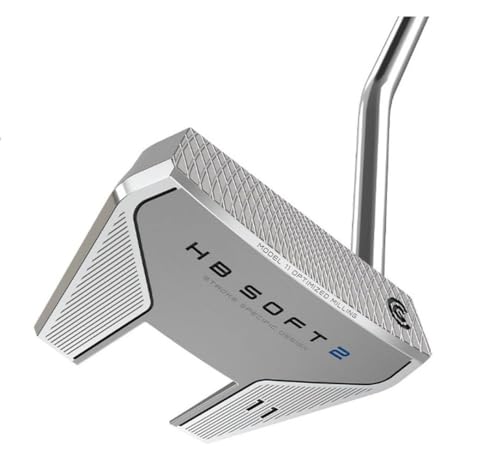
- Style: Oversized mallet
- Balance: Face balanced
- Insert: Soft polymer face
- Options: Single bend, oversized grip available
- Price: $150–$200
Cleveland’s HB Soft 2 line is designed with one clear philosophy: make putting as easy as possible for the widest range of golfers. The #11 head is an oversized mallet with high MOI, face-balanced design, and a soft polymer insert that produces a comfortable, responsive feel at impact. The oversized grip option (which adds weight to the handle and reduces wrist activity) is a particularly smart feature — larger grips are proven to reduce the small movements that cause puts to go off line.
The single bend shaft in this model keeps the face properly positioned at address for golfers with a straight stroke, and the clean sight lines make alignment straightforward. Cleveland has worked hard on the face insert to produce a roll that starts consistently and tracks online — the HB Soft 2 outperforms many competitors at similar price points in terms of initial roll quality.
For $150-$200, the HB Soft 2 #11 is exceptional value. It competes directly with the Odyssey White Hot OG in the budget mallet tier, and the choice between them largely comes down to personal preference — the Odyssey insert has a slightly different feel character, while the Cleveland’s oversized grip option gives it a unique practical advantage for golfers who want to quiet their hands. Both are excellent. The Cleveland edges it for golfers specifically battling the yips or excessive wrist action.
Scotty Cameron Special Select Newport 2

- Style: Blade
- Balance: Toe hang
- Face: Milled 303 German stainless steel
- Best For: Arc stroke, feel-focused players
- Price: $400–$500
The Scotty Cameron Newport 2 is the most aspirational putter in golf — the one that tour players and serious amateurs covet and that has won more PGA Tour events than any other putter model. The Special Select version features a milled 303 German stainless steel face with custom sole weights for optimal feel and balance. Tiger Woods won multiple major championships with a Newport-style Scotty Cameron. That tour pedigree isn’t just marketing; the precision of the milling and the quality of the 303 steel produces a feel that’s genuinely in a class of its own among blade putters.
The Newport 2 has a classic two-bar sight line that’s clean and easy to align without being distracting. The plumber’s neck hosel allows for a modest amount of face rotation through the arc stroke, making it suitable for golfers whose stroke follows a natural arc. The weight and balance feel right immediately — this is a putter that experienced golfers tend to pick up and not want to put down.
The honest counterpoint: at $400-$500, the Scotty Cameron is a premium purchase that some golfers buy for prestige as much as performance. A $200 Odyssey or Cleveland will make more putts in the hands of a golfer who practices less. The Scotty Cameron rewards commitment to the putting craft. If you’re serious about your game, take lessons and put in putting green time consistently — then the Scotty Cameron is a tool that rewards the work. If you’re an occasional golfer who picks up the clubs a few times a year, the White Hot OG is more appropriate.
Evnroll ER2

- Style: Mid-blade
- Balance: Slight toe hang
- Face: Gravity Grid (Sweet Face technology)
- Best For: Arc stroke, distance control focus
- Price: $200–$300
Evnroll is a niche brand that deserves more attention than it gets. The ER2’s defining feature is the Gravity Grid face milling — a proprietary pattern of variable-depth milling across the face that the brand claims redirects off-center hits closer to the intended line and normalizes ball speed across the face. Independent testing has supported the claim that off-center hits roll more consistently with the Evnroll face than with most competitors. For golfers who struggle with distance control on off-center putts specifically, this is worth paying attention to.
The ER2 mid-blade shape sits between a traditional blade and a mallet in terms of visual feedback and forgiveness. Slight toe hang suits a moderate arc stroke. The overall feel is distinctive — the milling creates a slightly different sound and sensation at impact that some golfers love immediately and others find takes adjustment. The quality of materials and machining is excellent for the price tier.
Evnroll won’t show up in your playing partner’s bag often, and tour victories aren’t in their marketing materials. But the Sweet Face technology is a genuinely interesting engineering approach to a real problem — off-center roll quality — and the ER2 delivers on its core promise. For $200-$300, it’s worth trying if you’re a feel-focused golfer who’s struggled to find a putter that keeps distance consistent across the face.
L.A.B. Golf DF3

- Style: Mallet
- Balance: Lie Angle Balanced (unique)
- Technology: Torque-free at address
- Best For: Arm-lock or unconventional stroke golfers
- Price: $400–$550
L.A.B. Golf builds putters around a genuinely novel concept: Lie Angle Balanced design. Traditional putters — whether face-balanced or toe-weighted — exert some torque on your hands at address and through the stroke. The L.A.B. DF3 is designed so that the putter is torque-free at the precise lie angle you address the ball. This eliminates the micro-compensations your wrists and hands make to control a traditional putter, theoretically allowing a more consistent, repeatable stroke with less mechanical interference.
The DF3 is designed to work optimally with an arm-lock putting style (where the grip locks against the forearm), though it can be used conventionally. Tour players who’ve switched to arm-lock — including some who struggled with the yips or inconsistent stroke patterns — have found meaningful improvement. The physics of the LAB design are sound, and the real-world results reported by convert golfers are compelling.
This is a specialty putter for a specific type of golfer: someone who is willing to experiment with their stroke technique, who is serious about putting improvement, and who is open to an unconventional setup. It’s not a casual purchase. But for the right golfer at the right time, the L.A.B. DF3 is the most genuinely innovative putter on this list.
Wilson Infinite Bucktown

- Style: Mallet
- Balance: Face balanced
- Insert: Microperf urethane face
- Best For: Budget-conscious golfers, straight stroke
- Price: $100–$150
The Wilson Infinite putter line is the brand’s entry into serious putter design at an accessible price, and the Bucktown mallet is the standout of the range. The microperf urethane face produces a soft, comfortable feel at impact — Wilson has clearly put genuine engineering effort into the insert rather than just slapping a generic soft face on a budget head. Face-balanced, high-MOI mallet design with clean sight lines makes this a straightforward choice for golfers who want a straight stroke and don’t want to spend $200+.
At $100-$150, this is the most budget-friendly option in our guide, and it outperforms its price in feel quality and build consistency. Wilson’s infinite perimeter weighting philosophy provides meaningful forgiveness on off-center hits. The standard pistol grip works well, and multiple length options (33″, 34″, 35″) are typically available.
The Wilson Infinite isn’t competing with a Scotty Cameron or Ping PLD on premium feel and prestige. But for a beginner who needs a solid putter without breaking the bank, or for a golfer building a backup bag, the Bucktown is an honest choice at an honest price. Don’t let budget constraints force you into a no-name knockoff — the Wilson Infinite delivers genuine quality for less than the competition’s price.
Buyer’s Guide: How to Choose the Right Putter
1. Match Putter to Your Stroke Type
The most important putter selection criterion is stroke type matching. Golfers with a natural arc stroke — where the face rotates open on the backswing and closes through impact — generally perform better with a slight toe hang putter like the Scotty Cameron Newport 2, Ping PLD Anser, or Evnroll ER2. Golfers with a straighter stroke — face stays more square throughout — perform better with face-balanced designs like the Odyssey White Hot OG, TaylorMade Spider GT, or Cleveland HB Soft. The easiest way to determine your stroke type: lay a club on the ground, take your address position over it, make your putting stroke, and observe whether the face stays square or opens and closes naturally. Better yet, book a 30-minute putting lesson.
2. Get the Right Length
Standard putter length is 34-35 inches for most adult golfers. Too long and you’ll stand too upright; too short and you’ll crouch. The ideal setup has your eyes directly over the ball or slightly inside the ball line, your arms hanging naturally from your shoulders, and your back relatively straight. Many golfers use putters that are too long — which tends to create a stroke that goes too far inside on the backswing. If you’re regularly struggling with putts going right (for a right-handed golfer), check your putter length and posture before changing your stroke.
3. Blade vs Mallet: The Real Decision
Mallets are more forgiving on off-center hits and better suit straight strokes. Blades offer more feedback on impact quality and are often preferred by experienced golfers with consistent arcing strokes who trust their touch. If you’re a beginner or high-handicapper, start with a mallet — the added forgiveness gives you more room for error while you develop consistency. As your handicap drops and you develop a more repeatable stroke, re-evaluate. Some of the best putters in the world use mallets; some use blades. It’s stroke type, not skill level, that determines the best fit.
4. Feel Is Real — And Personal
The feel of a putter at impact is a real, measurable characteristic — it’s determined by face material (milled stainless vs. aluminum insert vs. urethane insert), shaft material, head weight, and grip size. Milled faces feel firmer and more communicative; soft urethane inserts feel softer and more cushioned. Neither is objectively better — it’s what you prefer and what gives you the most confidence. Before spending $400 on a premium putter, try to test-putt similar options. Most golf retailers have putting mats where you can roll a few with different putters. That 5-minute test is worth more than reading reviews.
The Odyssey White Hot OG #7 is the best putter for most beginners — forgiving mallet design, excellent White Hot insert feel, face balanced for a straight stroke. The Cleveland HB Soft 2 is another excellent choice, especially with the oversized grip option for golfers who want to reduce wrist influence in the stroke.
Blade putters suit arcing strokes (face naturally rotates through impact). Mallet putters suit straight strokes and offer more forgiveness on off-center hits. Get a putting lesson to determine your natural stroke type, then match the putter to it. Both blade and mallet players win at every level of golf.
Standard is 34-35 inches for most adult golfers. Shorter golfers (under 5’7″) often prefer 33 inches, taller golfers (over 6’2″) may prefer 35-36 inches. The best way to determine length is a putting fitting where your posture, eye position, and arm hang are measured at your natural address position.
A Scotty Cameron or Ping PLD Milled can genuinely improve feel and confidence, which translates to better performance — but only if you practice consistently. A $150 Odyssey White Hot OG with regular putting practice will outperform a $450 Scotty Cameron that rarely sees a practice green. Buy the best putter you can afford, but invest in practice time equally.
A face-balanced putter, when balanced horizontally on your finger under the shaft, has the face pointing straight up. This promotes a straight stroke path. Toe-balanced (or toe-weighted) putters have the toe drop toward the ground and suit arcing strokes. Most mallets are face-balanced; most blades have some degree of toe hang.
Putter fitting is often the most impactful equipment fitting a golfer can receive. Correct loft, lie angle, length, and head design for your stroke type can meaningfully reduce three-putts. Even a 30-minute putting assessment at a golf shop with a good fitter is worth the time for any golfer who takes their score seriously.
Frequently Asked Questions
What is the best putter for a beginner golfer?
Blade vs mallet putter: which should I choose?
What putter length is right for me?
Is an expensive putter worth it?
What is face-balancing in a putter?
How important is putter fitting?