
What’s in this guide
If you’ve been shopping for golf tech lately, you’ve probably noticed two categories dominating the conversation: launch monitors and rangefinders. They’re both expensive-ish gadgets that promise to improve your game. But they do completely different things, and buying the wrong one first is a classic mistake.

Let’s break down exactly what each device does, who actually needs one (or both), and where your money is best spent depending on how you play.

What Each Device Actually Does
Rangefinders: Distance to the Target
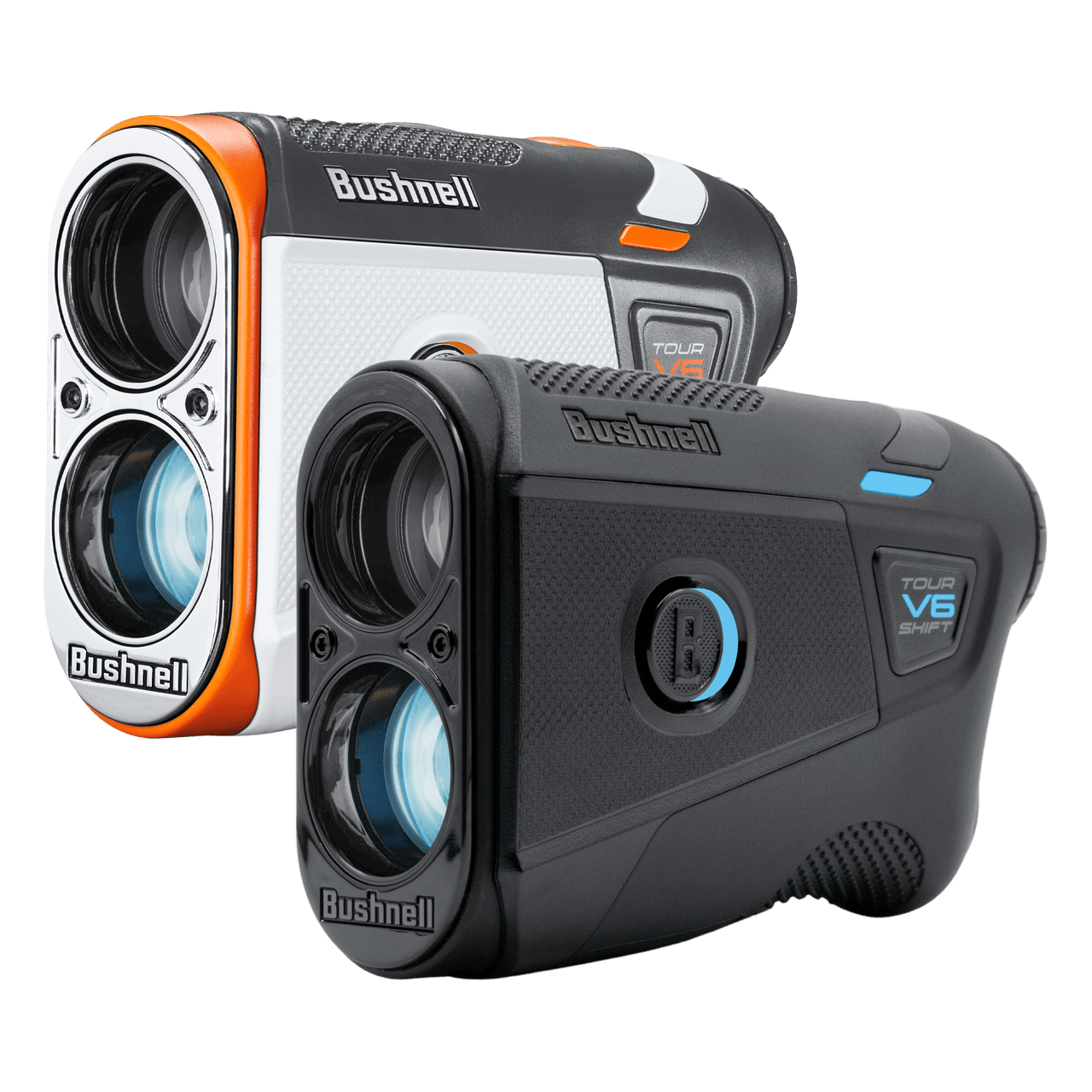
A golf rangefinder is a handheld device that uses a laser to measure the exact distance between you and a target — usually the flagstick, but it works on bunkers, trees, hazards, or anything else you can point it at. You look through the eyepiece, press a button, and get a yardage reading within about a yard of accuracy.
That’s it. That’s the whole job. A rangefinder answers one question: “How far away is that thing?”
Modern rangefinders also include slope compensation, which adjusts yardage for elevation changes. So if you’re hitting uphill to an elevated green 150 yards away, slope mode might tell you it “plays like” 163 yards. Extremely useful on hilly courses.
Launch Monitors: What Your Swing Actually Produces
A launch monitor tracks what happens to the ball (and often the club) at the moment of impact. Depending on the model, it measures things like:
- Ball speed — how fast the ball leaves the clubface
- Launch angle — how high the ball takes off
- Spin rate — backspin and sometimes sidespin
- Carry distance — how far the ball flies before landing
- Club head speed — how fast you’re swinging
- Smash factor — the efficiency of your strike
A launch monitor answers a completely different question: “What is my swing actually doing, and how far do I really hit each club?”
Some launch monitors also power golf simulators, letting you play virtual rounds on famous courses from your garage. But at their core, they’re diagnostic tools for understanding your game.
Key Differences at a Glance
| Feature | Rangefinder | Launch Monitor |
|---|---|---|
| Primary purpose | Measure distance to a target on the course | Measure ball flight and swing data |
| Where you use it | On the course, every round | Practice range, home setup, or fitting studio |
| What it tells you | How far to the pin/hazard/layup | How far you actually carry each club, spin, launch angle |
| Price range | $80–$500 | $200–$20,000+ |
| Frequency of use | Every shot on the course | Practice sessions and fittings |
| Skill level impact | Helps any golfer pick the right club | Helps you understand and improve your swing |
Who Needs a Rangefinder
If you play real rounds of golf on a real course — even just a few times a year — a rangefinder is the single most useful piece of golf tech you can own. Here’s why: most amateur golfers are wrong about their distances. Not by a little. By a lot.
Studies show the average recreational golfer misjudges distances by 10-15 yards on approach shots. That’s the difference between hitting the green and dumping it into a front bunker. A $90 rangefinder fixes that problem instantly.
You should buy a rangefinder if:
- You play on-course golf at least a few times a year
- You want to score better without changing your swing
- You don’t know your exact carry distances (or don’t trust the course markers)
- You play courses with elevation changes
Honestly, unless you exclusively hit balls at the driving range and never play rounds, a rangefinder should probably be your first golf tech purchase. Check out our Best Golf Rangefinders guide for our top picks at every price point.
Who Needs a Launch Monitor
A launch monitor is a training and improvement tool. It’s for the golfer who wants to understand their game at a deeper level — not just “how far is the pin,” but “how far do I actually carry my 7-iron, and why does it go right?”
You should buy a launch monitor if:
- You practice regularly and want feedback on every shot
- You don’t know your real carry distances with each club
- You’re working on swing changes and want to see the data
- You want to practice or play simulator golf at home
- You’re getting fitted for clubs and want your own baseline data
- You’re a numbers person who geeks out on spin rates and launch angles
Launch monitors have come down in price dramatically. You can get a solid personal launch monitor for $300-500 that gives you accurate carry distances, ball speed, and spin. The premium models ($2,000+) add full simulator capability and club path data.
For our top picks, see our Best Golf Launch Monitors guide.
Can You Use Both? (Yes, and Here’s Why)
Here’s where things get interesting. A rangefinder and a launch monitor are actually complementary tools, not competing ones. They’re solving different halves of the same problem:
- The launch monitor tells you: “Your 7-iron carries 155 yards.”
- The rangefinder tells you: “The pin is 158 yards away.”
- Together they tell you: “Hit a smooth 6-iron.”
Without a launch monitor, most golfers guess at their carry distances. Without a rangefinder, most golfers guess at the target distance. Using both eliminates guesswork from both sides of the equation.
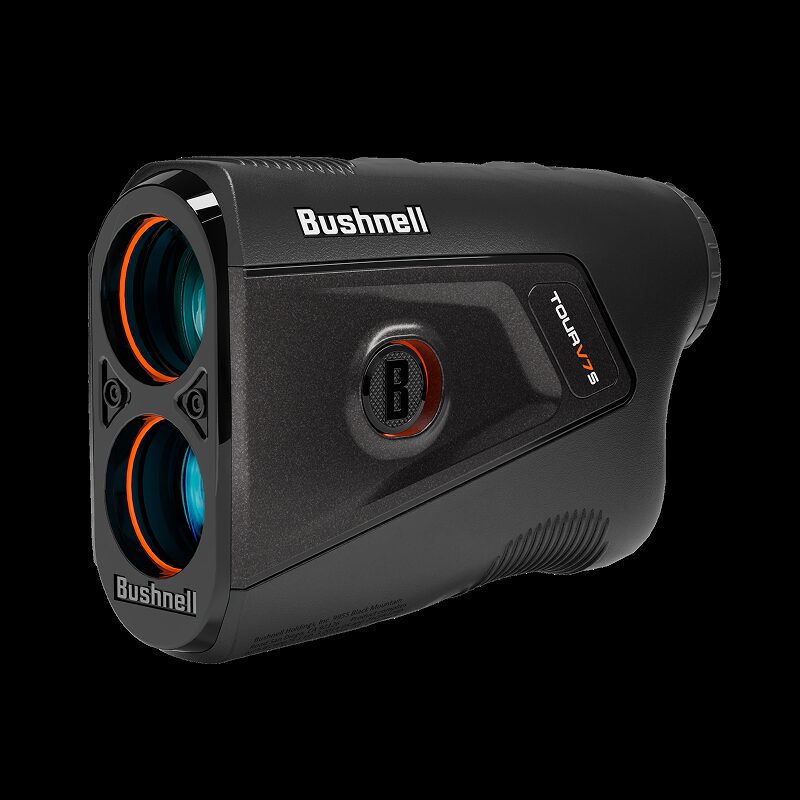
Some high-end rangefinders (like the Bushnell Tour V7 Shift) can even integrate with launch monitor data to suggest specific clubs based on your personal distances. That’s the future of on-course decision-making.
If you’re going to buy both eventually, start with the rangefinder. It’s cheaper, you’ll use it every round, and the scoring impact is immediate. Add a launch monitor later when you’re ready to dig into practice data.
Budget Considerations
Here’s a realistic look at what you’ll spend:
Rangefinder Budget
- $80-100: Gets you a solid budget rangefinder with slope. Perfectly functional for most golfers.
- $150-200: Better optics, magnetic mount, more reliable flag lock.
- $300-500: Premium optics, fastest acquisition, best build quality. For the serious golfer.
Launch Monitor Budget
- $200-500: Personal launch monitors with basic but useful data — ball speed, carry distance, sometimes spin. Great for learning your distances.
- $500-2,000: More accurate sensors, better spin data, some simulator compatibility.
- $2,000-5,000: Full simulator capability, radar or camera-based tracking, club path and face angle data.
- $5,000+: Tour-level accuracy, the same tech used in professional fittings.
If your total budget is $300 or less, buy a rangefinder. If your budget is $500-800, buy a rangefinder and a personal launch monitor. You’ll cover both sides of the distance equation.
The Verdict
Stop thinking of these as competing products. They do different jobs:
- A rangefinder helps you score better right now by telling you the exact distance to the target on every approach shot.
- A launch monitor helps you improve over time by giving you data-driven feedback on your swing and real carry distances.
If you play on-course golf and don’t own either, buy the rangefinder first. It’s the better bang-for-the-buck purchase and you’ll use it every single round. Add a launch monitor when you’re ready to level up your practice sessions.
If you mostly practice at the range and play infrequently, a launch monitor might actually be your better first purchase — it’ll make those range sessions dramatically more productive.
And if you can swing both? You’ll have the most complete picture of your game that technology can provide.
Frequently Asked Questions
No. A launch monitor tells you how far you hit the ball, but it can’t tell you how far away the pin is. You’d still need to know the distance to your target in order to pick the right club. Some GPS apps can fill that gap, but a laser rangefinder gives you the most accurate on-course yardage.
Under the USGA Rules of Golf, distance-measuring devices are allowed, but devices that measure conditions like wind or provide swing data are generally not permitted during a competitive round. In casual play, nobody cares. In tournaments, check the local rules — most prohibit launch monitors on the course.
You can get a perfectly functional setup for around $400 total. A budget rangefinder like the Gogogo GS24 runs about $90, and a personal launch monitor like the Swing Caddie SC200 Plus or Garmin Approach R10 can be found in the $200-300 range. That combo gives you on-course distance and practice data without breaking the bank.
Maybe not for distances alone — but launch monitors give you much more than carry numbers. Spin rate, launch angle, ball speed, and smash factor all help you diagnose swing issues and track improvement over time. If you’re working with a coach or making swing changes, a launch monitor provides the objective data that feelings can’t.
A rangefinder, without question. Beginners benefit the most from knowing the actual distance to the target because their distance judgment is the least calibrated. A $90 rangefinder will shave more strokes off your game than a $500 launch monitor when you’re starting out. Once you’re consistently breaking 100 and practicing regularly, that’s when a launch monitor starts paying dividends.
More Buying Guides
- Best Golf Simulators for Home 2026: Complete Packages Compared
- Best Golf Launch Monitors 2026: 10 Models Tested at Every Price Point
- Best Golf GPS Watches 2026: 8 Top Picks Tested & Compared
- Best Golf GPS Devices 2026: 8 Handhelds Tested on the Course
- Best Golf Simulators Under 00 in 2026
- Best Golf Rangefinders with Slope 2026: 8 Models with Slope Technology Explained
Improve Your Game