
Our Top Picks at a Glance
What’s in this guide
- Side-by-Side Comparison
- Titleist Vokey SM10 — Best Overall
- Cleveland RTX 6 ZipCore — Best for Spin
- Callaway Jaws Raw — Best for Versatility
- TaylorMade Hi-Toe 3 — Best for Open Face Shots
- Ping Glide 4.0 — Most Forgiving
- Mizuno T24 — Best Feel
- Cleveland CBX Full Face 2 — Best for High Handicaps
- Kirkland Signature Wedge Set — Best Budget
- How to Choose a Golf Wedge
-
Build the perfect wedge setup with our Wedge Gapping Calculator.
Frequently Asked Questions
Wedges are the scoring clubs. They’re the ones that turn a good approach into a tap-in birdie or a bad lie into a scrambling par save. Yet most golfers spend weeks agonizing over their driver and grab whatever wedge is on sale. That’s backwards.
I’ve tested dozens of wedges over the past decade, tracked spin numbers on a launch monitor, and beaten up grooves on practice greens to see how they hold up. Here are the 8 best golf wedges you can buy in 2026 — from tour-level precision to a Costco set that has no business performing this well at the price.
Side-by-Side Comparison
| Wedge | Price | Lofts | Grinds | Finish | Groove Type | Best For | |
|---|---|---|---|---|---|---|---|
| Titleist Vokey SM10 Best Overall | ~$189 | 46°–62° | 6 (F, S, M, K, T, D) | Tour Chrome, Jet Black, Nickel | Spin Milled | Serious golfers | View |
| Cleveland RTX 6 ZipCore Best Spin | ~$160 | 46°–62° | 4 (Low, Mid, Full, Low+) | Tour Satin, Black Satin | HydraZip | Spin maximizers | View |
| Callaway Jaws Raw Most Versatile | ~$180 | 48°–62° | 5 (S, W, X, C, Z) | Chrome, Black Plasma | Razor Offset | Shot creators | View |
| TaylorMade Hi-Toe 3 | ~$170 | 50°–62° | 3 (SB, LB, HB) | Chrome, Copper | Full-Face Milled | Open face shots | View |
| Ping Glide 4.0 Most Forgiving | ~$170 | 46°–60° | 4 (SS, ES, WS, TS) | Hydropearl 2.0 | Precision Milled | Consistency seekers | View |
| Mizuno T24 | ~$170 | 46°–62° | 5 (S, D, C, V, X) | White Satin, Denim Copper, Raw | QuadCut+ | Feel-focused players | View |
| Cleveland CBX Full Face 2 High Handicaps | ~$150 | 50°–60° | 1 (V-Sole) | Chrome | UltiZip Full Face | Game improvement | View |
| Kirkland Signature Set Best Budget | ~$169 (3-pc) | 52°, 56°, 60° | 1 per loft | Chrome | CNC Milled | Budget-conscious | View |

Titleist Vokey SM10
The most-played wedge on the PGA Tour gets even better. Six grinds, 25 loft/bounce combos, and spin milled grooves that bite.
~$189
46°–62°
4°–14°
F, S, M, K, T, D
Tour Chrome, Jet Black, Nickel
Spin Milled
~$189
The Vokey SM10 is the wedge that every other wedge is measured against. Bob Vokey’s team has been refining this design for over two decades, and the SM10 represents the most complete wedge lineup available. With six tour-proven grinds and 25 unique loft/bounce/grind combinations, there’s a configuration for every swing type and course condition.
The Spin Milled grooves are individually cut for each loft — lower lofts get narrower, deeper grooves for full-swing control, while higher lofts get wider, shallower grooves that maximize spin on partial shots and flops. The progressive CG placement shifts the center of gravity forward in lower lofts and back in higher lofts, matching how you actually use each wedge.
The SM10 also introduces a refined forward CG on the pitching wedge lofts (46°-50°) that promotes a more penetrating ball flight on full approach shots — a subtle but meaningful improvement for scoring from 100-130 yards out.
Pros
- Most loft/bounce/grind options of any wedge on the market
- Spin Milled grooves optimized per loft — not one-size-fits-all
- Progressive CG placement matches real-world usage
- Three premium finishes to choose from
- Most-played wedge on the PGA Tour — proven at every level
- Exceptional turf interaction across all grinds
Cons
- $189 per wedge — three wedges costs $567
- So many options can be overwhelming without a fitting
- Tour Chrome finish shows wear quickly

Cleveland RTX 6 ZipCore
Cleveland’s HydraZip face technology and low-density ZipCore deliver the most spin of any wedge we tested. Period.
~$160
46°–62°
6°–14°
Low, Mid, Full, Low+
Tour Satin, Black Satin
HydraZip
~$160
Cleveland has been the spin king for years, and the RTX 6 ZipCore is their best work yet. The HydraZip face treatment combines a dynamic blast with laser-milled lines between the grooves — this creates micro-texture that grips the ball in ways that grooves alone can’t. On a launch monitor, the RTX 6 consistently produced the highest spin numbers in our testing.
The ZipCore — a low-density core in the center of the club — redistributes mass to increase MOI by up to 20%. In plain English: you get more consistent spin and distance even on off-center strikes. That’s huge for amateurs who don’t always hit the sweet spot.
At $160, it’s also $29 less per wedge than the Vokey SM10. If pure spin is what you’re after — and you want to save some money — the RTX 6 is the wedge to beat.
Pros
- Highest spin numbers in our testing — HydraZip is legit
- ZipCore technology boosts MOI for off-center forgiveness
- $29 less per wedge than the Vokey SM10
- New Low+ grind option on sand wedge lofts
- Laser-milled micro-texture between grooves
Cons
- Fewer grind options than Vokey or Jaws Raw
- Black Satin finish wears fast
- Shape at address is slightly larger — may not appeal to purists

Callaway Jaws Raw
Five grinds, a raw face that rusts for more friction, and the most shot-shaping versatility in the game. The creative player’s wedge.
~$180
48°–62°
4°–14°
S, W, X, C, Z
Chrome, Black Plasma
Razor Offset grooves
~$180
The Jaws Raw is the wedge for golfers who see more than one way to play every shot. With five distinct grind options, you can find a sole configuration that works for your swing, your course conditions, and the specific shots you need to hit.
The “Raw” in the name is literal — the face is left unplated, which means it develops a rust patina over time. This isn’t cosmetic: raw steel creates more micro-friction between the ball and face, increasing spin — especially in wet conditions where chrome faces tend to lose grip. It’s a favorite trick of tour players, and Callaway built it right in.
The Razor Offset grooves feature an aggressive edge geometry that grabs the ball immediately at impact. Combined with the raw face, this wedge produces exceptional greenside spin on those touchy 30-50 yard pitch shots where amateurs leave the most strokes on the table.
Pros
- Raw face increases spin and improves wet-condition performance
- Five grind options — something for every playing style
- Razor Offset grooves are aggressively effective
- Black Plasma finish looks incredible at address
- Excellent for creative shot-making around the greens
Cons
- Raw face requires acceptance of rust — some golfers hate the look
- Doesn’t start 46° — need another brand for gap wedge
- Narrow sole on some grinds punishes poor contact
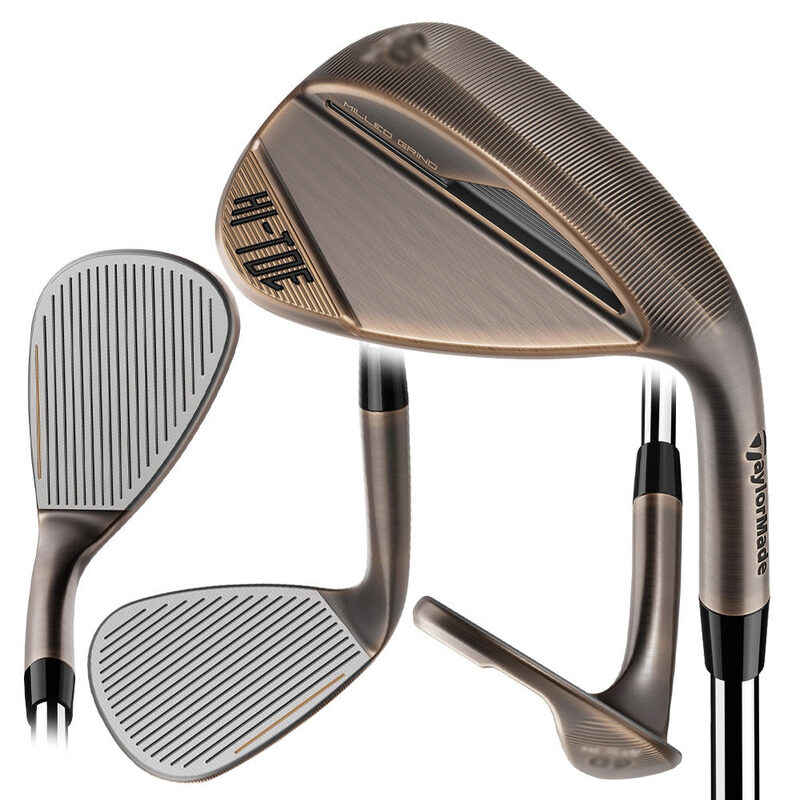
TaylorMade Hi-Toe 3
Full-face grooves and an extended toe design that maintain spin even when you lay the face wide open. Purpose-built for bunkers and flops.
~$170
50°–62°
7°–13° (SB, LB, HB)
Standard, Low, High bounce
Chrome, Copper
Full-face milled grooves
~$170
The Hi-Toe 3 does one thing better than any other wedge on this list: it keeps grooves on the ball when the face is wide open. The extended toe height and full-face groove pattern mean that even when you open the face 30-40 degrees for a bunker explosion or a high flop, the ball is still making contact with milled grooves rather than a smooth surface.
That matters more than most golfers realize. On a standard wedge, when you open the face significantly, the ball starts hitting above the top groove line — and you lose spin completely. The Hi-Toe 3 eliminates this problem by extending grooves all the way to the top of the face.
The Copper finish is a standout — it develops a unique patina over time and looks stunning at address. The aged-copper look after a few rounds is something you either love or hate, but it’s undeniably distinctive.
Pros
- Full-face grooves maintain spin on open-face shots
- Extended toe design is purpose-built for bunker play
- Copper finish develops a beautiful patina
- Excellent from tight lies around the green
- Three bounce options cover most conditions
Cons
- No lofts below 50° — can’t use as a gap wedge
- Larger profile at address may bother some players
- Copper finish isn’t for everyone aesthetically

Ping Glide 4.0
Precision-milled grooves, an elastomer insert for feel, and Ping’s Hydropearl 2.0 finish. The wedge that protects you from bad swings.
~$170
46°–60°
8°–14°
SS, ES, WS, TS
Hydropearl 2.0 Chrome
Precision milled
~$170
Ping builds the most forgiving clubs in golf, and the Glide 4.0 carries that DNA into the wedge category. The wider sole designs and higher bounce angles across the lineup make this the wedge that’s hardest to hit fat or thin. If you’re the kind of golfer who dreads greenside bunker shots, the Glide 4.0 will change your life.
The Hydropearl 2.0 finish repels water and moisture, which maintains friction between the face and ball in dew, rain, or early-morning rounds. It’s a subtle technology, but it means your spin numbers stay consistent from the first hole to the last — even on a wet morning.
Ping also included a larger activated elastomer insert behind the face that improves feel and dampens harsh vibrations on off-center hits. The result is a wedge that feels soft even when you chunk it slightly — which is encouraging for mid-to-high handicap players building confidence around the greens.
Pros
- Most forgiving sole designs in this roundup
- Hydropearl 2.0 finish maintains spin in wet conditions
- Elastomer insert provides excellent feel
- Wider soles help prevent digging
- Four grind options still give decent versatility
Cons
- Max loft of 60° — no 62° option
- Wider soles reduce versatility on tight lies
- Not available through all standard retail channels

Mizuno T24
Grain Flow Forged in Hiroshima from a single billet of 1025E carbon steel. Nothing else feels like a Mizuno at impact.
~$170
46°–62°
4°–14°
S, D, C, V, X
Soft White Satin, Denim Copper, Tour Raw
QuadCut+ grooves
~$170
There’s a reason Mizuno iron enthusiasts are borderline evangelical about the brand: nothing else feels like a Grain Flow Forged Mizuno at impact. The T24 is forged from a single billet of 1025E Pure Select mild carbon steel at Mizuno’s iconic facility in Hiroshima, Japan. The result is a buttery-soft feel that transmits precise feedback through your hands on every shot.
The QuadCut+ grooves are a step up from the previous T-Series. The groove shoulder camber and taper have been refined to allow a tighter groove pattern, which increases spin rates across the face — not just on center strikes. Five sole profiles (S, D, C, V, X) provide plenty of fitting flexibility.
The Denim Copper finish is the most visually striking option on this list — a blue-copper patina that darkens over time and looks like nothing else in your bag. The Tour Raw finish, like the Jaws Raw, develops a rust layer that adds micro-friction for extra spin.
Pros
- Best feel of any wedge — Grain Flow Forged in Hiroshima
- QuadCut+ grooves deliver competitive spin numbers
- Five grind options for proper fitting
- Denim Copper finish is unique and stunning
- Tour Raw finish adds spin over time
Cons
- Softer steel wears faster than cast alternatives
- Forged construction means less forgiveness on mishits
- Harder to find in stock at retail — Mizuno distribution is limited

Cleveland CBX Full Face 2
Cavity-back forgiveness meets full-face grooves. Designed for golfers who want help around the greens without a tour-level swing.
~$150
50°–60°
12° (all lofts)
V-Sole (single versatile grind)
Chrome
UltiZip full-face grooves
~$150
Most wedges on this list are designed for good players. The CBX Full Face 2 is designed for everyone else — and that’s not an insult. Cleveland combined a cavity-back design (the same forgiveness technology that makes game-improvement irons easier to hit) with full-face grooves that deliver spin even on off-center strikes.
The V-Sole grind is a single, do-everything configuration. There’s no grind matrix to stress about, no fitting session required. The wide, versatile sole works from fairway, rough, and sand without demanding perfect technique. For a 15+ handicap, that simplicity is a feature, not a limitation.
The cavity-back design also allows for a graphite shaft option — a rarity in wedges. If you play graphite shafts in your irons, the CBX Full Face 2 lets you maintain consistent weighting and feel throughout the bag. That alone makes it the obvious wedge for many senior golfers and players with slower swing speeds.
Pros
- Cavity-back design provides iron-like forgiveness
- Full-face grooves generate spin even on toe and heel strikes
- V-Sole simplifies the buying decision — one grind works everywhere
- Graphite shaft option for consistent weighting with iron sets
- Most affordable tour-quality wedge on this list
Cons
- 12° bounce on all lofts — no low-bounce option for firm conditions
- Cavity-back look at address may not appeal to low handicaps
- Less workability than blade-style wedges

Kirkland Signature Gen 2 Wedge Set
Three CNC-milled wedges (52°, 56°, 60°) for $169. That’s $56 per wedge. The Costco disruptor strikes again.
~$169 (3-wedge set)
52°, 56°, 60° (fixed set)
10° (52°), 12° (56°), 10° (60°)
One per loft (fixed)
Chrome
CNC milled
~$169 (3-piece set)
Costco did it again. The Kirkland Signature Gen 2 wedge set includes three CNC-milled wedges for what most brands charge for a single club. At roughly $56 per wedge, these shouldn’t be good. But they are.
The Gen 2 improved on the original with refined sole grinds, sharper CNC-milled grooves, and better shafts. Independent testing from MyGolfSpy found spin numbers within 200-300 RPM of wedges costing three times as much. For the vast majority of amateurs, that difference is invisible on the course.
The 52°/56°/60° loft spread covers the three essential wedge slots for most golfers. The bounce angles (10°/12°/10°) are middle-of-the-road — safe choices that work in most conditions. You don’t get the fitting options of a Vokey or RTX, but you get a complete wedge set for the price of one premium wedge.
Pros
- Three wedges for ~$169 — unbeatable value
- CNC-milled grooves produce competitive spin numbers
- 52/56/60 loft spread covers all essential wedge shots
- Gen 2 improvements address original model’s weaknesses
- Clean, no-nonsense design at address
Cons
- No grind or bounce options — one-size-fits-all
- Can’t buy individual lofts — must buy the set
- Availability is inconsistent — Costco stock comes and goes
- No left-handed option in the Gen 2
How to Choose a Golf Wedge in 2026
Loft Gapping: The Most Important Thing Nobody Talks About
The single biggest mistake golfers make with wedges is having gaps in their loft coverage. Your pitching wedge (typically 43°-46° on modern iron sets) creates a gap between your shortest iron and your first dedicated wedge. Every 4° of loft roughly equals 10-12 yards of distance, so a gap of 8° between clubs means you have a 20+ yard dead zone with no good option.
Here’s how to gap your wedges properly:
- Check your PW loft first. Look it up — modern game-improvement PWs can be as strong as 43°.
- Space wedges 4°-6° apart. 4° gaps give tighter distance control. 6° gaps are acceptable if you’re comfortable with half-swings.
- Common 3-wedge setup: 50°, 54°, 58° (for a 46° PW) or 52°, 56°, 60° (for a 48° PW)
- Common 4-wedge setup: 48°, 52°, 56°, 60° (for a 44° PW)
Bounce Explained: Why It Matters More Than Loft
Bounce is the angle between the leading edge and the lowest point of the sole. It’s what prevents the club from digging into the turf. Think of it as the club’s built-in forgiveness for imperfect contact.
- Low bounce (4°-8°): Best for firm conditions, tight lies, and players with shallow, sweeping swings. Less forgiving if you hit behind the ball.
- Mid bounce (8°-12°): The most versatile range. Works in most conditions and for most swing types. When in doubt, choose mid bounce.
- High bounce (12°-14°+): Best for soft conditions, fluffy sand, and players with steep, digger-style swings. The sole glides through turf instead of sticking. Incredibly forgiving in bunkers.
The simple rule: If you tend to hit your wedges fat (chunking), you need more bounce. If you tend to blade or skull your wedge shots, you might have too much bounce. Most golfers should lean toward mid-to-high bounce — it’s the more forgiving choice.
Grind Types: What They Do
A grind is the shaping of the sole — material is removed from the heel, toe, or trailing edge to change how the club interacts with the turf. More grind options mean more fitting precision.
- Full/Standard grind: No material removed. Maximum bounce effect. Best for full-swing wedge shots and bunkers.
- Mid grind: Slight heel and toe relief. Versatile — works for full swings and open-face shots.
- Low/Narrow grind: Aggressive material removal. Sits closer to the ground. Best for tight lies and players who manipulate the face.
- Wide sole grind: Extra material on the sole for maximum forgiveness. Best for high-handicap players and soft conditions.
If you don’t know what grind to choose, start with the manufacturer’s mid or “standard” option. It’s the safest all-around choice.
How Many Wedges Should You Carry?
Most golfers should carry three wedges (gap, sand, lob) in addition to their PW. That gives you 14 clubs total if you also carry driver, 3-wood, hybrid, and 5-PW irons — the standard setup.
Here’s the breakdown by skill level:
- High handicaps (20+): Two wedges are fine — a sand wedge (54°-56°) and one more (58°-60°). Carrying a 60° lob wedge you can’t hit consistently does more harm than good.
- Mid handicaps (10-20): Three wedges — gap (50°-52°), sand (54°-56°), and lob (58°-60°). This is the sweet spot for most golfers.
- Low handicaps (<10): Three to four wedges, depending on your iron set. Many single-digit handicaps carry four wedges and drop the 3-wood or 5-iron.
When to Replace Your Wedges
Wedge grooves wear out faster than any other club in your bag because of the high-spin, turf-heavy contact. Here’s how to know when it’s time:
- The thumbnail test: Run your thumbnail across the grooves. If they feel smooth or rounded instead of sharp and grabby, they’re worn.
- Spin drop-off: If your wedge shots that used to check up and spin back are now releasing and rolling out, worn grooves are the most likely culprit.
- General timeline: Tour players replace wedges every 60-75 rounds. Amateurs who practice regularly should consider new wedges every 1-2 years. Casual golfers (10-15 rounds per year) can get 3-4 years out of a set.
- Practice mat damage: If you hit off mats at the range, your grooves are wearing faster than you think. Mats are more abrasive than turf. Budget players: this is another reason the Kirkland set makes sense — replace more often for less money.
How Much Should You Spend?
Here’s the honest truth: all wedges on this list will spin the ball within 10% of each other when the grooves are fresh. The differences come down to feel, grind options, fitting precision, and how long the grooves stay sharp.
Our recommendations by golfer type:
- Budget-conscious / new to golf: Kirkland Signature Set (~$56/wedge) — get all three for less than one premium wedge
- Mid-handicap who practices: Cleveland RTX 6 ZipCore ($160) or Ping Glide 4.0 ($170) — great performance with some fitting options
- Serious golfer who gets fitted: Titleist Vokey SM10 ($189) or Callaway Jaws Raw ($180) — maximum grind/bounce options for a precise fit
- Feel-obsessed player: Mizuno T24 ($170) — nothing else feels like Grain Flow Forged
Frequently Asked Questions
Start with your pitching wedge loft and space your wedges 4°-6° apart. The most common setup is a gap wedge (50°-52°), sand wedge (54°-56°), and lob wedge (58°-60°). If your PW is 44° or stronger, consider adding a fourth wedge (48°) to fill the gap. The goal is to have no yardage gap larger than 12-15 yards between consecutive clubs.
For most golfers, 10°-12° of bounce on a sand wedge is the safest choice. Higher bounce (12°-14°) works better if you play in soft conditions or have a steep downward strike. Lower bounce (8°-10°) suits firm conditions or shallow, sweeping swings. If you’re unsure, err toward more bounce — it’s the more forgiving option, especially from bunkers.
It depends on how often you play and practice. Tour players replace wedges every 60-75 rounds. Amateurs who play and practice regularly should replace wedges every 1-2 years. Casual golfers who play 10-15 rounds per year can get 3-4 years out of a set. If you practice off mats frequently, replace more often — mats wear grooves faster than grass.
Not necessarily. A lob wedge is useful for high flop shots, deep bunker escapes, and situations where you need the ball to stop quickly. But many high-handicap golfers hit better results with a 56° or 58° than a 60° because the higher loft is harder to hit consistently. If you skull your 60° more than you flush it, drop it and use your sand wedge with an open face instead.
Bounce is a measurement — the angle between the leading edge and the sole’s lowest point. Grind is the shape of the sole — how material is removed from the heel, toe, and trailing edge. A wedge can have the same bounce angle but different grinds. Think of bounce as “how much” the sole sits off the ground, and grind as “where and how” the sole contacts the turf. Both affect turf interaction, but grind determines versatility.
In terms of raw spin numbers, the Kirkland wedges perform within 200-300 RPM of wedges costing 3x more — which is barely noticeable on the course. Where premium wedges justify their price is in grind/bounce options, feel, and fitting precision. If you know exactly what grind and bounce you need, a fitted Vokey or RTX will outperform the Kirkland set. If you don’t know or don’t care, the Kirklands are an incredible value.
Ideally, yes. Matching shaft weight and flex across your irons and wedges promotes consistent feel and swing weight. That said, some players prefer a slightly heavier wedge shaft for added control on partial shots. If you play steel in your irons, play steel in your wedges. If you play graphite irons, look at the Cleveland CBX Full Face 2 — it’s one of the few wedges that offers a graphite shaft option.
Slightly. Raw finishes (unplated steel) develop rust over time, which creates micro-texture that can increase spin — especially in wet conditions. Chrome finishes are more durable and stay looking new longer, but the smooth plating offers marginally less friction. Black finishes (PVD or plasma) reduce glare at address, which some golfers prefer. The performance differences are small, but real — raw finishes do produce measurably more spin in wet conditions.
More Buying Guides
- Best Golf Clubs for Seniors 2026: Complete Sets for Distance and Forgiveness
- How to Choose a Golf Driver: The Complete Guide
- Best Golf Clubs for Beginners 2026: Complete Sets Compared
- Best Golf Irons for Beginners 2026: 8 Forgiving Sets Compared
- Best Drivers for Beginning Golfers 2026: 8 Forgiving Drivers That Launch Easy
- Best Golf Grips 2026: 8 Grips for Better Feel and Control
{
“@context”: “https://schema.org”,
“@type”: “ItemList”,
“name”: “Best Golf Wedges 2026”,
“description”: “Our top picks for golf wedges, tested and reviewed for spin, feel, and forgiveness.”,
“numberOfItems”: 8,
“itemListElement”: [
{
“@type”: “ListItem”,
“position”: 1,
“item”: {
“@type”: “Product”,
“name”: “Titleist Vokey SM10 Golf Wedge”,
“description”: “Best overall golf wedge with 6 grinds, 25 loft/bounce combinations, and Spin Milled grooves optimized per loft.”,
“brand”: {“@type”: “Brand”, “name”: “Titleist”},
“offers”: {
“@type”: “Offer”,
“price”: “189.00”,
“priceCurrency”: “USD”,
“availability”: “https://schema.org/InStock”,
“url”: “https://www.amazon.com/dp/B0D9BZ5LYC?tag=grumgoph09-20”
}
}
},
{
“@type”: “ListItem”,
“position”: 2,
“item”: {
“@type”: “Product”,
“name”: “Cleveland RTX 6 ZipCore Golf Wedge”,
“description”: “Best wedge for spin with HydraZip face technology and low-density ZipCore for increased MOI.”,
“brand”: {“@type”: “Brand”, “name”: “Cleveland”},
“offers”: {
“@type”: “Offer”,
“price”: “159.99”,
“priceCurrency”: “USD”,
“availability”: “https://schema.org/InStock”,
“url”: “https://www.amazon.com/s?k=Our+Top+Picks+at+a+Glance&tag=grumgoph09-20”
}
}
},
{
“@type”: “ListItem”,
“position”: 3,
“item”: {
“@type”: “Product”,
“name”: “Callaway Jaws Raw Golf Wedge”,
“description”: “Most versatile golf wedge with 5 grinds, raw face for increased spin, and Razor Offset grooves.”,
“brand”: {“@type”: “Brand”, “name”: “Callaway”},
“offers”: {
“@type”: “Offer”,
“price”: “179.99”,
“priceCurrency”: “USD”,
“availability”: “https://schema.org/InStock”,
“url”: “https://www.amazon.com/dp/B0B7FYDVQY?tag=grumgoph09-20”
}
}
},
{
“@type”: “ListItem”,
“position”: 4,
“item”: {
“@type”: “Product”,
“name”: “TaylorMade Hi-Toe 3 Golf Wedge”,
“description”: “Best wedge for open face shots with full-face milled grooves and extended toe design.”,
“brand”: {“@type”: “Brand”, “name”: “TaylorMade”},
“offers”: {
“@type”: “Offer”,
“price”: “169.99”,
“priceCurrency”: “USD”,
“availability”: “https://schema.org/InStock”,
“url”: “https://www.amazon.com/dp/B0CBSJ9HL3?tag=grumgoph09-20”
}
}
},
{
“@type”: “ListItem”,
“position”: 5,
“item”: {
“@type”: “Product”,
“name”: “Ping Glide 4.0 Golf Wedge”,
“description”: “Most forgiving golf wedge with Hydropearl 2.0 finish, elastomer insert, and precision milled grooves.”,
“brand”: {“@type”: “Brand”, “name”: “Ping”},
“offers”: {
“@type”: “Offer”,
“price”: “169.99”,
“priceCurrency”: “USD”,
“availability”: “https://schema.org/InStock”,
“url”: “https://www.amazon.com/s?k=Our+Top+Picks+at+a+Glance&tag=grumgoph09-20”
}
}
},
{
“@type”: “ListItem”,
“position”: 6,
“item”: {
“@type”: “Product”,
“name”: “Mizuno T24 Golf Wedge”,
“description”: “Best feel golf wedge with Grain Flow Forged 1025E carbon steel and QuadCut+ grooves.”,
“brand”: {“@type”: “Brand”, “name”: “Mizuno”},
“offers”: {
“@type”: “Offer”,
“price”: “169.99”,
“priceCurrency”: “USD”,
“availability”: “https://schema.org/InStock”,
“url”: “https://www.amazon.com/s?k=Our+Top+Picks+at+a+Glance&tag=grumgoph09-20”
}
}
},
{
“@type”: “ListItem”,
“position”: 7,
“item”: {
“@type”: “Product”,
“name”: “Cleveland CBX Full Face 2 Golf Wedge”,
“description”: “Best wedge for high handicaps with cavity-back design, full-face UltiZip grooves, and V-Sole.”,
“brand”: {“@type”: “Brand”, “name”: “Cleveland”},
“offers”: {
“@type”: “Offer”,
“price”: “149.99”,
“priceCurrency”: “USD”,
“availability”: “https://schema.org/InStock”,
“url”: “https://www.amazon.com/dp/B0BT1KP2G7?tag=grumgoph09-20”
}
}
},
{
“@type”: “ListItem”,
“position”: 8,
“item”: {
“@type”: “Product”,
“name”: “Kirkland Signature Gen 2 3-Piece Golf Wedge Set”,
“description”: “Best budget golf wedge set with CNC milled grooves, three wedges (52, 56, 60) for under $170.”,
“brand”: {“@type”: “Brand”, “name”: “Kirkland Signature”},
“offers”: {
“@type”: “Offer”,
“price”: “169.00”,
“priceCurrency”: “USD”,
“availability”: “https://schema.org/InStock”,
“url”: “https://www.amazon.com/s?k=Kirkland+Signature+Wedge+Set&tag=grumgoph09-20”
}
}
}
]
}
{
“@context”: “https://schema.org”,
“@type”: “FAQPage”,
“mainEntity”: [
{
“@type”: “Question”,
“name”: “What degree wedges should I carry?”,
“acceptedAnswer”: {
“@type”: “Answer”,
“text”: “Start with your pitching wedge loft and space your wedges 4-6 degrees apart. The most common setup is a gap wedge (50-52 degrees), sand wedge (54-56 degrees), and lob wedge (58-60 degrees). If your PW is 44 degrees or stronger, consider adding a fourth wedge (48 degrees) to fill the gap.”
}
},
{
“@type”: “Question”,
“name”: “What bounce should I choose for a sand wedge?”,
“acceptedAnswer”: {
“@type”: “Answer”,
“text”: “For most golfers, 10-12 degrees of bounce on a sand wedge is the safest choice. Higher bounce (12-14 degrees) works better in soft conditions or with steep swings. Lower bounce (8-10 degrees) suits firm conditions or shallow swings. When in doubt, err toward more bounce.”
}
},
{
“@type”: “Question”,
“name”: “How often should I replace my wedges?”,
“acceptedAnswer”: {
“@type”: “Answer”,
“text”: “Tour players replace wedges every 60-75 rounds. Amateurs who play and practice regularly should replace wedges every 1-2 years. Casual golfers who play 10-15 rounds per year can get 3-4 years out of a set. Practicing off mats wears grooves faster than grass.”
}
},
{
“@type”: “Question”,
“name”: “Do I need a lob wedge (60 degrees)?”,
“acceptedAnswer”: {
“@type”: “Answer”,
“text”: “Not necessarily. A lob wedge is useful for high flop shots and deep bunker escapes, but many high-handicap golfers get better results with a 56 or 58 degree wedge. If you skull your 60 degree more than you flush it, consider dropping it and using your sand wedge with an open face.”
}
},
{
“@type”: “Question”,
“name”: “What’s the difference between a grind and a bounce?”,
“acceptedAnswer”: {
“@type”: “Answer”,
“text”: “Bounce is a measurement — the angle between the leading edge and the sole’s lowest point. Grind is the shape of the sole — how material is removed from the heel, toe, and trailing edge. A wedge can have the same bounce angle but different grinds. Bounce determines how much the sole sits off the ground; grind determines where and how the sole contacts the turf.”
}
},
{
“@type”: “Question”,
“name”: “Are the Kirkland wedges really as good as premium wedges?”,
“acceptedAnswer”: {
“@type”: “Answer”,
“text”: “In terms of raw spin numbers, the Kirkland wedges perform within 200-300 RPM of wedges costing 3x more. Where premium wedges justify their price is in grind and bounce options, feel, and fitting precision. If you know exactly what grind and bounce you need, a fitted Vokey or RTX will outperform. If you don’t, the Kirklands are incredible value.”
}
},
{
“@type”: “Question”,
“name”: “Should my wedge shafts match my iron shafts?”,
“acceptedAnswer”: {
“@type”: “Answer”,
“text”: “Ideally, yes. Matching shaft weight and flex across your irons and wedges promotes consistent feel and swing weight. Some players prefer a slightly heavier wedge shaft for added control on partial shots. If you play graphite irons, the Cleveland CBX Full Face 2 offers a graphite shaft option.”
}
},
{
“@type”: “Question”,
“name”: “Chrome vs. raw vs. black finish — does it affect performance?”,
“acceptedAnswer”: {
“@type”: “Answer”,
“text”: “Slightly. Raw finishes develop rust over time, creating micro-texture that increases spin, especially in wet conditions. Chrome finishes are more durable but offer marginally less friction. Black finishes reduce glare at address. The performance differences are small but measurable — raw finishes produce more spin in wet conditions.”
}
}
]
}